Construction Cost Management: Complete Guide to Controlling Project Costs in 2026
 BoqCalc Team
Successful construction projects are not determined solely by good design or efficient execution. They also depend on effective financial management. Every decision, from estimating and procurement to scheduling and change management, has a direct impact on the final project cost.
This is where construction cost management becomes essential.
Contractors who actively monitor budgets, control costs, and identify financial risks throughout the project lifecycle are far more likely to deliver profitable projects. In contrast, poor cost management often leads to budget overruns, delayed schedules, disputes, and reduced margins.
In this guide, you'll learn what construction cost management is, why it matters, the biggest cost challenges facing contractors, and how AI-powered software is transforming the way construction companies manage project finances.
What Is Construction Cost Management?
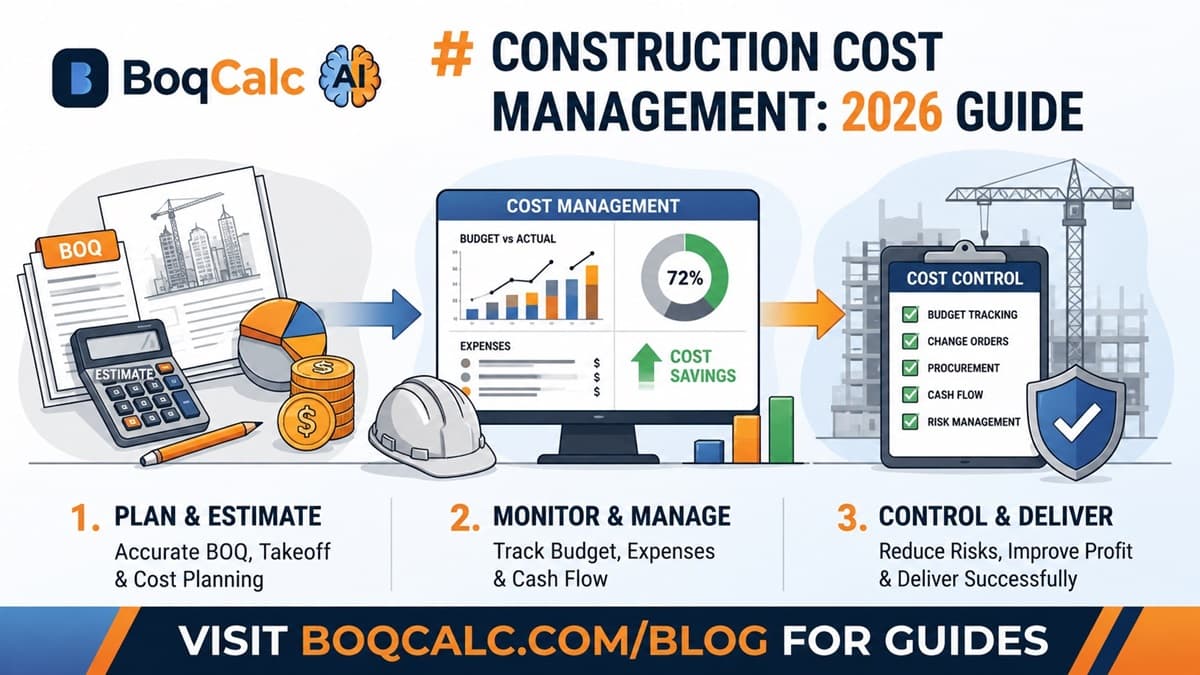
Construction cost management is the process of planning, estimating, budgeting, monitoring, and controlling project costs from the initial tender through project completion.
Rather than focusing only on the original estimate, cost management continues throughout the entire construction lifecycle.
A complete construction cost management process includes:
- Cost estimation
- Quantity takeoffs
- Bill of Quantities (BOQ) preparation
- Budget planning
- Procurement tracking
- Change order management
- Cash flow forecasting
- Cost reporting
- Risk analysis
The goal is simple: deliver projects within budget while maintaining quality and profitability.
Why Construction Cost Management Is Important
Construction projects involve thousands of cost-related decisions.
Without a structured cost management process, contractors often experience:
- Budget overruns
- Material waste
- Procurement delays
- Cash flow problems
- Scope creep
- Reduced profit margins
- Contract disputes
Effective construction cost management provides greater financial visibility, helping teams make informed decisions before small issues become major problems.
The Construction Cost Management Process
A successful cost management strategy follows several key stages.
1. Cost Estimation
Every project begins with an estimate.
Accurate estimating establishes the baseline budget and forms the foundation for project planning.
To understand how AI improves this process, read our guide to AI Construction Cost Estimation.
2. Quantity Takeoff
Reliable estimates require accurate quantities.
Modern Quantity Takeoff Software helps contractors measure project quantities quickly while reducing manual errors.
Digital takeoffs improve estimating accuracy and reduce the time required to prepare tenders.
3. Bill of Quantities (BOQ)
After quantities have been measured, they are organized into a structured Bill of Quantities.
A BOQ creates consistency throughout pricing, procurement, and project execution.
Learn how AI automates this process in our article on AI Bill of Quantities Generator.
4. Cost Planning
Once the BOQ is complete, contractors assign unit rates, labor costs, equipment costs, subcontractor pricing, overheads, and contingency allowances.
Accurate pricing is essential for maintaining healthy profit margins.
Our guide to BOQ Price explains this process in greater detail.
5. Budget Monitoring
Construction budgets should never remain static.
Throughout execution, project managers monitor:
- Actual costs
- Committed costs
- Remaining budget
- Procurement spending
- Labor productivity
- Equipment utilization
Regular monitoring allows teams to identify financial issues before they impact profitability.
Common Challenges in Construction Cost Management
Even experienced contractors face challenges when controlling project costs.
Material Price Volatility
Construction material prices can fluctuate significantly during long-term projects.
Without continuous monitoring, original estimates quickly become outdated.
Scope Changes
Client requests, design revisions, and unexpected site conditions often introduce additional costs.
Tracking change orders is essential for maintaining budget control.
Poor Communication
Disconnected spreadsheets and isolated project data often result in inconsistent financial reporting.
Manual Processes
Many contractors still rely on Excel for cost tracking.
While spreadsheets remain useful, they become increasingly difficult to manage as project complexity grows.
Construction Cost Management vs Cost Control
Although these terms are often used interchangeably, they are not identical.
Construction cost management covers the entire financial lifecycle of a project.
Cost control focuses specifically on monitoring and reducing costs during project execution.
Effective cost control is one part of a broader cost management strategy.
How AI Improves Construction Cost Management
Artificial intelligence is changing how contractors manage project finances.
Modern AI platforms can:
- Analyze project documentation
- Generate Bills of Quantities
- Detect missing scope
- Identify estimating risks
- Forecast project costs
- Predict cash flow
- Compare tender revisions
- Highlight pricing inconsistencies
Instead of reacting to cost overruns, contractors can identify risks before they affect the project.
Risk Management and Cost Control
Financial risk is closely connected to construction cost management.
Hidden risks often include:
- Missing BOQ items
- Incomplete drawings
- Procurement delays
- Unrealistic schedules
- Design inconsistencies
Understanding these risks before tender submission can significantly improve project profitability.
Our guide to Construction Tender Risk Analysis explains how contractors identify commercial and technical risks using AI.
Benefits of Construction Cost Management Software
Modern construction cost management software provides significant advantages over manual workflows.
Better Financial Visibility
Project teams gain real-time insight into budgets and spending.
Faster Decision-Making
Centralized project information improves collaboration between estimators, project managers, and commercial teams.
Reduced Errors
Automation reduces repetitive manual calculations and data entry mistakes.
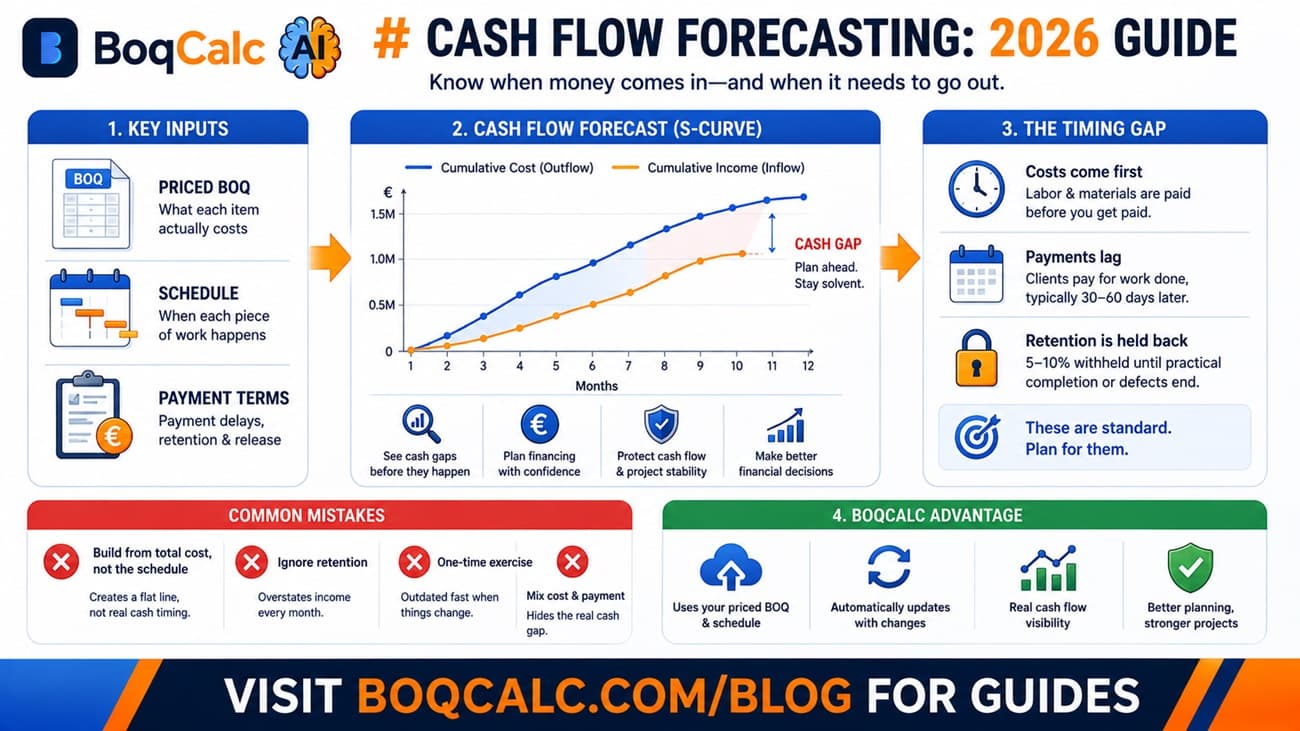
Improved Cash Flow Planning
Forecasting future expenditure helps contractors manage working capital more effectively.
Higher Profitability
Better financial control leads to stronger project margins.
Why Contractors Are Moving Toward AI
Construction projects are becoming increasingly complex.
Manual processes struggle to keep pace with larger projects, tighter schedules, and rising material costs.
AI-powered software allows contractors to:
- Estimate faster
- Improve BOQ accuracy
- Monitor budgets continuously
- Detect project risks earlier
- Forecast financial performance
This enables construction companies to make smarter commercial decisions throughout the project lifecycle.
For a real-world example, see how contractors reduce estimating time by up to 80% using AI BOQ Estimation.
Choosing the Right Construction Cost Management Software
When selecting software, look for features such as:
- Quantity takeoffs
- BOQ generation
- Cost estimation
- Cash flow forecasting
- Budget tracking
- AI-powered document analysis
- Risk identification
- Collaboration tools
- Cloud access
Integrated platforms eliminate duplicate work while improving project accuracy.
Frequently Asked Questions
What is construction cost management?
Construction cost management is the process of planning, estimating, budgeting, monitoring, and controlling project costs throughout the entire construction lifecycle.
Why is construction cost management important?
It helps contractors reduce financial risk, control budgets, improve forecasting, and increase project profitability.
How does AI improve construction cost management?
AI automates estimating, BOQ generation, quantity analysis, cash flow forecasting, and risk detection, allowing contractors to make faster and more informed decisions.
What is the difference between cost estimation and cost management?
Cost estimation calculates expected project costs before construction begins, while cost management continuously monitors and controls costs throughout the project.
Who benefits from construction cost management software?
General contractors, subcontractors, developers, quantity surveyors, consultants, and project managers all benefit from better cost visibility and financial control.
Conclusion
Construction cost management is no longer just about tracking expenses. It is about making informed financial decisions throughout the entire project lifecycle.
By combining accurate estimating, quantity takeoffs, BOQ management, budgeting, forecasting, and AI-powered analysis, contractors can reduce financial risk while improving profitability and project performance.
Modern platforms like BoqCalc bring these capabilities together in one intelligent solution, helping construction professionals manage costs more efficiently, prepare stronger tenders, and deliver successful projects with greater confidence.
BoqCalc Team
From the BoqCalc team
Ready to price your next BOQ?
4 free credits, no credit card. Upload a BOQ and see the cost estimate, risk analysis, schedule, and cash flow for yourself.
Try BoqCalc free →