Quantity Takeoff Software: The Complete Guide for Contractors in 2026
 BoqCalc Team
Every successful construction project starts with accurate quantities.
Before pricing a project, preparing a Bill of Quantities (BOQ), or submitting a tender, contractors must determine exactly how much material, labor, and equipment will be required. This process is known as quantity takeoff, and it forms the foundation of every reliable construction estimate.
Traditional quantity takeoffs rely heavily on manual measurements, spreadsheets, and printed drawings. While this approach has been used for decades, it is slow, repetitive, and prone to costly errors.
Modern quantity takeoff software automates much of this work, helping contractors save time, improve accuracy, and prepare competitive bids faster than ever before.
In this guide, you'll learn how quantity takeoff software works, why it matters, and how AI is transforming the estimating process.
What Is Quantity Takeoff Software?
Quantity takeoff software is a digital tool used to measure and calculate construction quantities directly from project documentation.
Instead of measuring drawings manually and entering values into spreadsheets, contractors can use software to extract quantities much faster.
Typical quantity takeoffs include:
- Concrete volumes
- Steel quantities
- Masonry areas
- Flooring
- Roofing
- Painting
- Drywall
- Electrical installations
- Plumbing systems
These quantities become the basis for project pricing and cost estimation.
Why Quantity Takeoffs Matter
Every construction estimate depends on accurate quantities.
If quantities are incorrect, every calculation that follows will also be incorrect.
Poor quantity takeoffs often result in:
- Underpriced bids
- Budget overruns
- Material shortages
- Delayed projects
- Reduced profit margins
For contractors competing in today's market, accurate quantity takeoffs are no longer optional. They are essential.
Traditional Quantity Takeoff Challenges
Many contractors still perform quantity takeoffs manually.
A typical workflow includes:
- Reviewing PDF drawings
- Measuring dimensions manually
- Recording quantities in Excel
- Organizing work by trade
- Verifying calculations
- Preparing BOQs
While effective, this process has several disadvantages:
- Time-consuming
- Repetitive
- Difficult to review
- High risk of human error
- Poor collaboration
Large commercial projects may require several days just to complete the quantity takeoff.
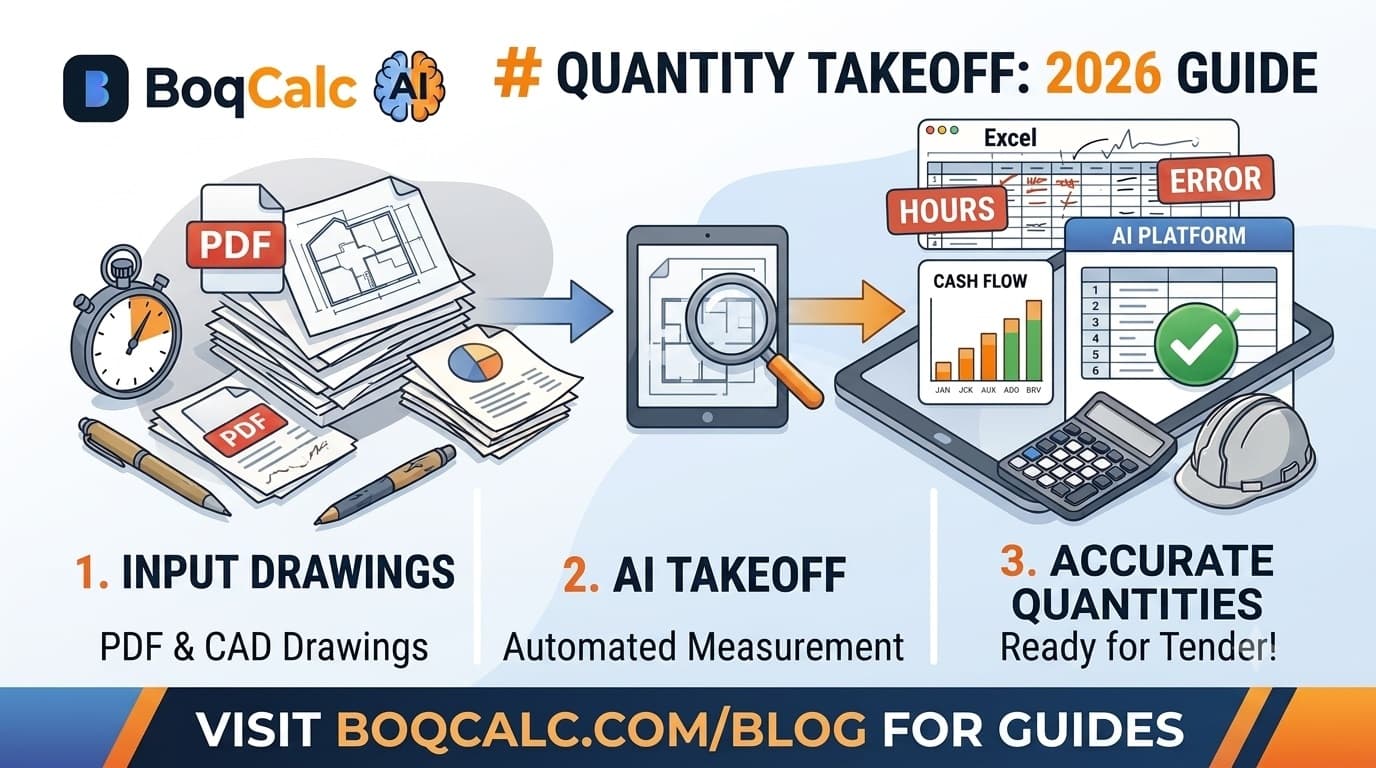
How Quantity Takeoff Software Works
Modern quantity takeoff software simplifies the estimating workflow.
Upload Project Documents
Users upload:
- PDF drawings
- CAD files
- Specifications
- BOQs
The software analyzes project documentation digitally.
Measure Quantities
Instead of measuring manually, estimators can calculate:
- Areas
- Lengths
- Volumes
- Counts
- Surface measurements
within minutes.
Organize by Trade
Software automatically groups quantities into construction trades, making estimating much easier.
Export Results
Completed takeoffs can be exported directly into estimating software, spreadsheets, or BOQs.
AI Is Changing Quantity Takeoffs
Artificial intelligence is making quantity takeoff even faster.
Instead of simply measuring drawings, AI can:
- Detect construction elements
- Identify work items
- Classify trade packages
- Verify quantities
- Detect missing scope
- Highlight inconsistencies
This significantly reduces manual work while improving estimate quality.
If you'd like to understand how AI improves estimating across the entire workflow, read our guide to AI Construction Cost Estimation.
Quantity Takeoff vs Bill of Quantities
These terms are often confused.
A quantity takeoff measures project quantities.
A Bill of Quantities (BOQ) organizes those quantities into a structured pricing document.
In simple terms:
Quantity Takeoff → BOQ → Cost Estimate → Tender Submission
For exactly where a priced BOQ stops and a full cost estimate begins, see our guide to BOQ vs cost estimate.
Modern AI solutions can automate every stage of this process.
If you're interested in automated BOQ creation, read our article on AI Bill of Quantities Generator.
Benefits of Quantity Takeoff Software
Faster Estimating
Projects that once required several days can often be completed within hours.
Improved Accuracy
Digital measurements reduce manual calculation errors.
Better Collaboration
Estimators, project managers, and quantity surveyors can work from the same data.
More Competitive Bids
Faster estimating allows contractors to respond to more tenders.
Reduced Costs
Automation reduces administrative work and improves productivity.
Features to Look For
Not all quantity takeoff software offers the same capabilities.
Look for features such as:
- PDF support
- CAD compatibility
- Automatic measurements
- BOQ generation
- AI quantity detection
- Cost estimation integration
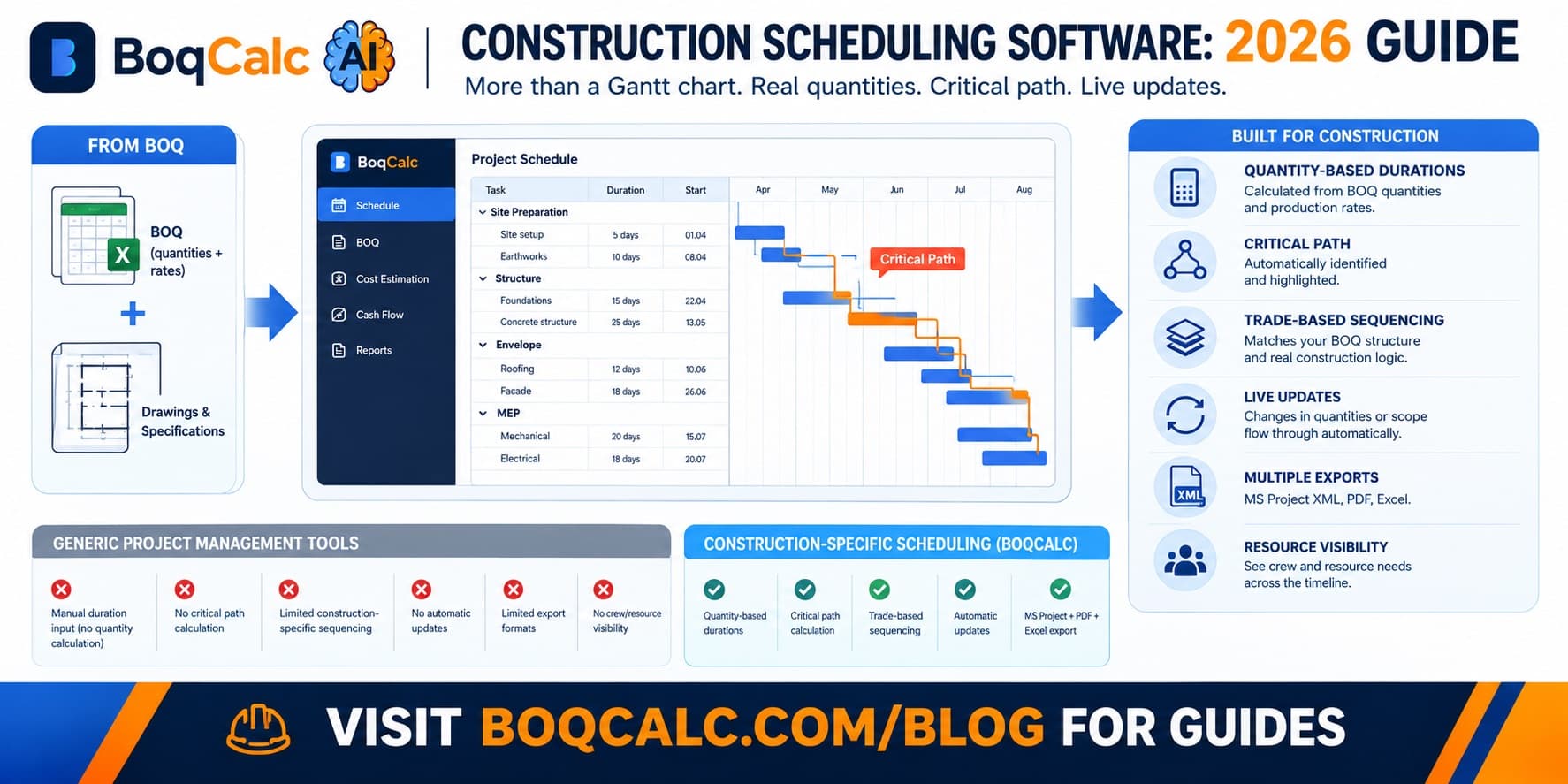
- Schedule generation
- Risk analysis
- Cloud collaboration
Quantity Takeoff Software vs Excel
| Feature | Excel | Quantity Takeoff Software |
|---|---|---|
| Digital Measurements | ❌ | ✅ |
| Automatic Quantities | ❌ | ✅ |
| Drawing Integration | ❌ | ✅ |
| Collaboration | Limited | Excellent |
| Error Detection | Limited | Advanced |
| Speed | Slow | Fast |
While Excel remains useful for calculations, dedicated takeoff software dramatically improves efficiency.
Quantity Takeoff and BOQ Pricing
Once quantities have been measured, the next step is assigning prices.
Accurate quantity takeoffs produce more reliable BOQ prices, helping contractors prepare competitive bids while protecting profit margins.
Learn more in our guide to BOQ Price.
Reducing Risk During Quantity Takeoffs
Even accurate measurements are only part of the estimating process.
Contractors must also identify:
- Missing specifications
- Drawing inconsistencies
- Scope gaps
- Commercial risks
Our guide to Construction Tender Risk Analysis explains how AI helps identify these issues before submitting a tender.
AI Quantity Takeoff in Modern Construction
The future of quantity surveying is increasingly automated.
Modern AI platforms combine:
- Quantity takeoffs
- BOQ generation
- Cost estimation
- Schedule creation
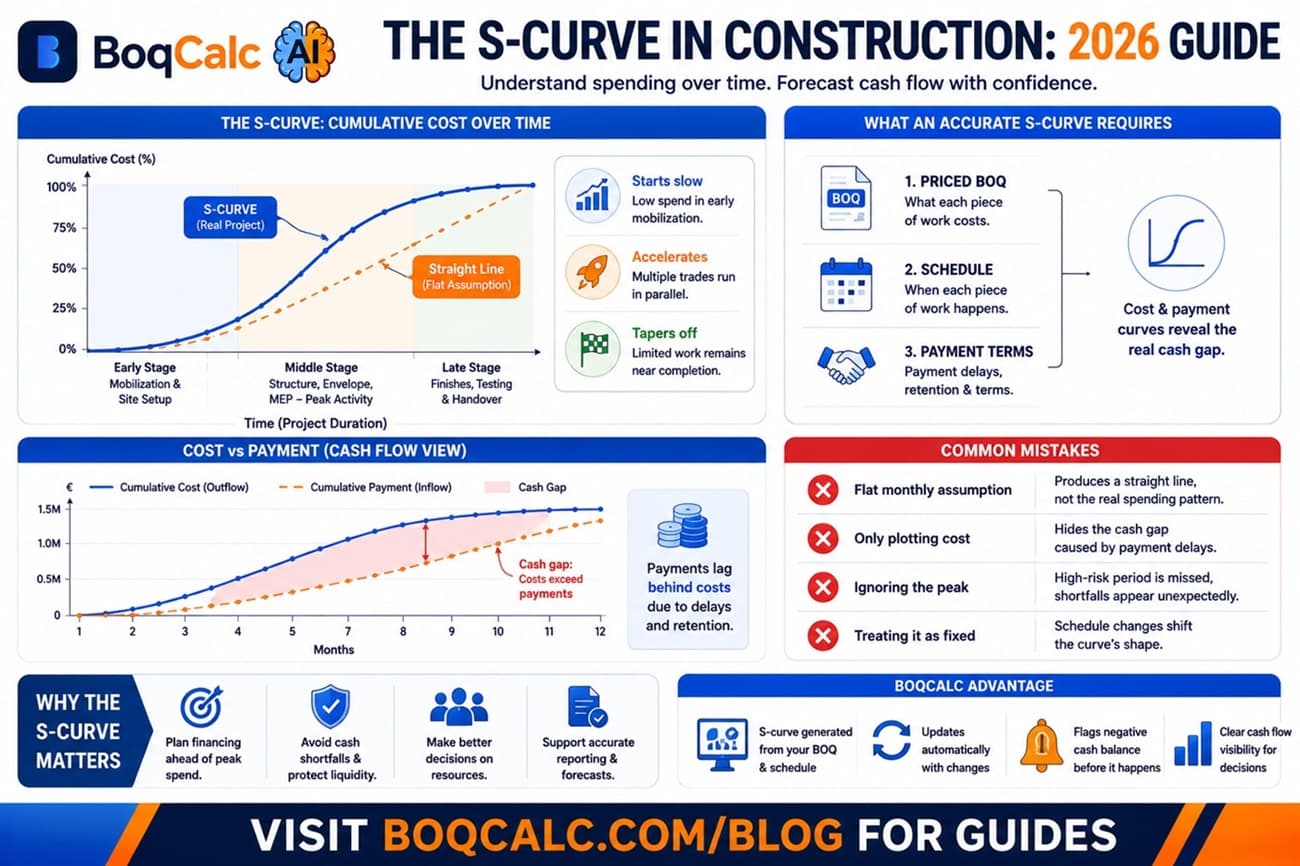
- Cash flow forecasting
- Risk analysis
into one intelligent workflow.
This allows contractors to prepare more accurate bids while significantly reducing manual work.
You can also see how contractors reduce estimating time by up to 80% in our article AI BOQ Estimation: How Contractors Save 80% Time Using Automation.
Why Contractors Are Moving to AI
Construction projects continue to grow in size and complexity.
Manual takeoffs simply cannot match the speed and consistency of AI-assisted estimating.
Modern contractors need:
- Faster bidding
- More accurate quantities
- Better cost control
- Higher estimating capacity
- Lower commercial risk
AI-powered quantity takeoff software delivers all of these benefits.
Frequently Asked Questions
What is quantity takeoff software?
Quantity takeoff software measures quantities from construction drawings and prepares data for estimating and BOQ creation.
Is quantity takeoff software better than Excel?
Yes. Dedicated takeoff software automates measurements, reduces errors, and improves collaboration.
Can AI perform quantity takeoffs?
Modern AI platforms can automatically detect construction elements, calculate quantities, and organize work items significantly faster than manual workflows.
Who uses quantity takeoff software?
General contractors, quantity surveyors, estimators, developers, subcontractors, and engineering firms all benefit from digital quantity takeoffs.
Can quantity takeoff software generate BOQs?
Many modern solutions integrate quantity takeoffs directly with BOQ generation and construction estimating.
Conclusion
Accurate quantity takeoffs are the foundation of every successful construction estimate.
Modern quantity takeoff software helps contractors measure faster, reduce errors, improve collaboration, and prepare more competitive bids.
As AI continues to transform construction estimating, companies that automate quantity takeoffs will gain a significant advantage in speed, accuracy, and profitability.
Discover how BoqCalc combines AI quantity takeoffs, BOQ generation, construction estimating, scheduling, cash flow forecasting, and risk analysis into one intelligent platform built for modern contractors.
BoqCalc Team
From the BoqCalc team
Ready to price your next BOQ?
4 free credits, no credit card. Upload a BOQ and see the cost estimate, risk analysis, schedule, and cash flow for yourself.
Try BoqCalc free →