BOQ vs Cost Estimate: What's the Actual Difference (and Why It Costs Money to Confuse Them)
 BoqCalc Team
"Can you send over the BOQ?" and "Can you send over the cost estimate?" get used as if they mean the same thing, and on a small job the difference barely matters. On anything bigger, mixing them up is how a number that was never meant to be final ends up quoted to a client as if it were one.
What a Bill of Quantities Actually Is
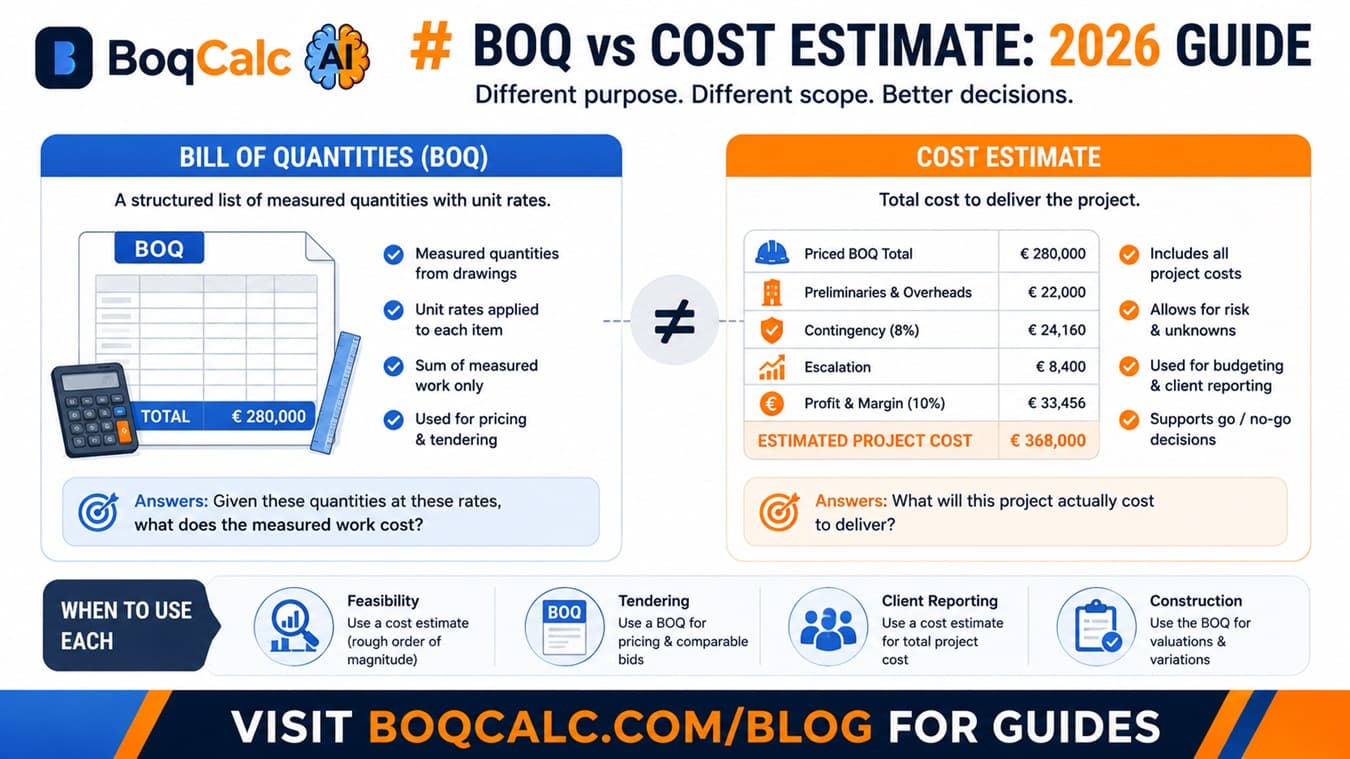
A BOQ is a structured, itemized list of measured quantities, line by line, trade by trade, with a unit rate against each one. It's built from drawings and specifications, and every quantity in it is measured, not guessed. Once priced, it totals up to a number, but that number is the sum of its line items, nothing more and nothing less.
A BOQ answers one question: given exactly these quantities, at these rates, what does the measured work cost?
What a Cost Estimate Actually Is
A cost estimate is broader and, critically, involves judgment that a BOQ doesn't. It answers a different question: what will this project actually cost to deliver?
That includes everything a priced BOQ covers, plus:
- Preliminaries and site overheads: costs that aren't tied to a specific measured item (site setup, temporary works, supervision, insurance)
- Contingency: an allowance for risk and the unknowns that haven't been fully designed or specified yet
- Profit and margin: a business decision, not a measured quantity
- Escalation: anticipated price movement over the project's duration
- Provisional and prime cost sums: placeholders for work that can't be firmly quantified yet
A cost estimate can exist before a BOQ does. A feasibility-stage estimate is often built from benchmarks and rough order-of-magnitude figures, long before there's enough design detail to measure a proper BOQ. Later, once the BOQ exists, it becomes the most reliable input into a much more accurate estimate.
How They Actually Relate
| Bill of Quantities | Cost Estimate | |
|---|---|---|
| What it measures | Specific, drawn quantities | Total project delivery cost |
| Includes preliminaries/contingency/profit | No | Yes |
| Exists before design is finalized | Rarely, needs measurable drawings | Yes, at feasibility stage |
| Primary use | Pricing, tendering, valuation | Budgeting, client reporting, go/no-go decisions |
| Who "owns" the number | Whoever measured and priced it | Whoever is accountable for project delivery cost |
The BOQ is an input into the estimate, not a substitute for one. A well-priced BOQ can still produce a bad cost estimate if nobody adds contingency, overhead, and margin on top of it.
A Worked Example
Say a priced BOQ for a small commercial fit-out totals €280,000: every measured item, priced correctly. Turning that into an actual cost estimate might look like:
| Line | Amount |
|---|---|
| Priced BOQ total | €280,000 |
| Preliminaries (site setup, supervision) | +€22,000 |
| Contingency (8%, design still developing) | +€24,160 |
| Escalation (6-month program) | +€8,400 |
| Margin (10%) | +€33,456 |
| Estimated project cost | ≈€368,000 |
The BOQ total and the final estimate differ by roughly 31% here, not because the BOQ was wrong, but because the BOQ was never trying to answer the same question the estimate does. Treating €280,000 as "the cost" would be a genuine, avoidable mistake.
Where the Mix-Up Actually Costs Money
The confusion isn't just semantic. It shows up in real numbers in a few predictable ways:
Quoting the BOQ total as the estimate. A client sees a priced BOQ, reads the bottom-line total, and treats it as "the cost," without contingency, without preliminaries, without margin. When the real number comes in 15-20% higher, it looks like the estimate was wrong, when actually no estimate was ever done.
Skipping contingency because "the BOQ is accurate." A precisely measured BOQ still doesn't account for design development, unforeseen ground conditions, or scope the drawings didn't yet show. Precision in the BOQ doesn't buy certainty in the project.
Comparing a rough estimate to a detailed BOQ price and assuming something's wrong. A feasibility-stage estimate and a fully-measured, priced BOQ are answering different questions at different levels of detail. A gap between them isn't automatically an error in either one.
Which One You Actually Need, When
- Feasibility / early decision-making → a cost estimate, built from benchmarks, because there's nothing to measure yet.
- Tendering / contractor pricing → a BOQ, because the client needs comparable, itemized bids from multiple contractors against the same measured quantities.
- Client-facing budget reporting → a cost estimate, because the client cares about total delivery cost, not line-item detail.
- Valuations and variations during construction → the BOQ, because it's the reference document for what was priced and what's changed.
Most projects use both, at different stages, for different audiences, which is exactly why keeping the distinction clear matters.
Frequently Asked Questions
Is a priced BOQ the same as a cost estimate? No. A priced BOQ totals the measured line items. A cost estimate adds preliminaries, contingency, and margin on top to represent the actual expected project cost.
Which comes first, the BOQ or the estimate? Usually a rough estimate exists first, at feasibility stage, before there's enough design detail to measure a proper BOQ. The BOQ then becomes the basis for a far more accurate estimate later.
Why would a BOQ total and a cost estimate for the same project be different? Because the estimate includes items the BOQ deliberately doesn't: preliminaries, contingency, escalation, and margin. A gap between the two is expected, not a red flag by itself.
Do I need both documents for a small project? For a small, simple job, a single priced document that includes a contingency line can serve both purposes. The distinction matters more as project size and risk grow.
Conclusion
The BOQ measures; the estimate judges. Confusing the two isn't just a vocabulary slip. It's how contingency gets forgotten, how a rough number gets treated as a firm one, and how a perfectly accurate BOQ still produces a project that comes in over budget. Getting a BOQ priced accurately with AI BOQ estimation is the reliable part of the equation, building the full cost estimate on top of it, deliberately, is what turns that number into something you can actually budget against.
BoqCalc Team
From the BoqCalc team
Ready to price your next BOQ?
4 free credits, no credit card. Upload a BOQ and see the cost estimate, risk analysis, schedule, and cash flow for yourself.
Try BoqCalc free →