Why Contractors Run Out of Cash Mid-Project
 BoqCalc Team
A contractor can price a job correctly, win it at a healthy margin, and still find themselves unable to pay subcontractors partway through. That contradiction confuses people the first time they see it, because it doesn't match how projects get evaluated at bid stage. Profitable and solvent are not the same question, and the gap between them is where a lot of otherwise well-run projects get into real trouble.
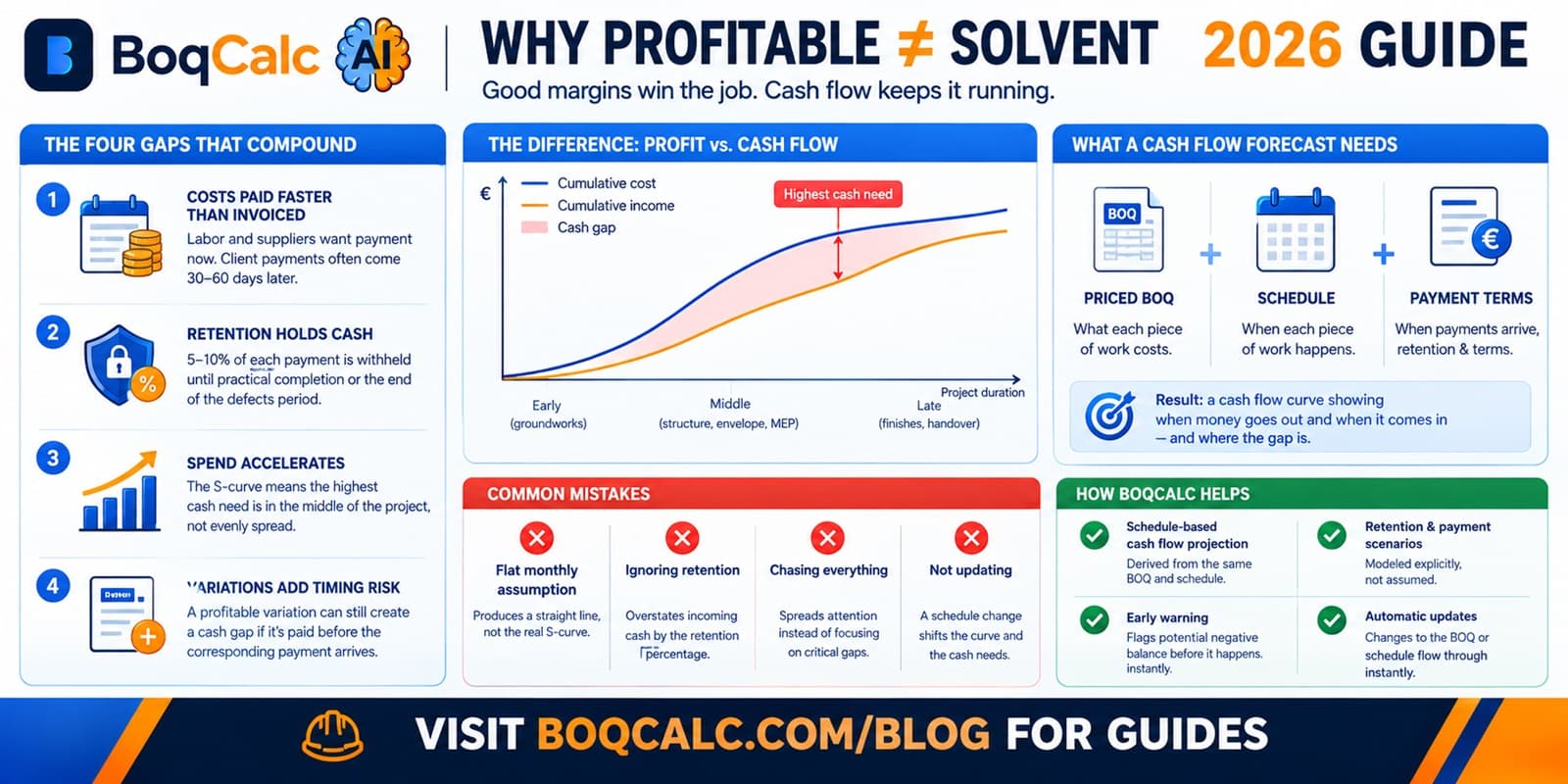
The Four Gaps That Compound
No single one of these is unusual on its own. What causes a real cash crisis is usually two or three of them landing at the same time.
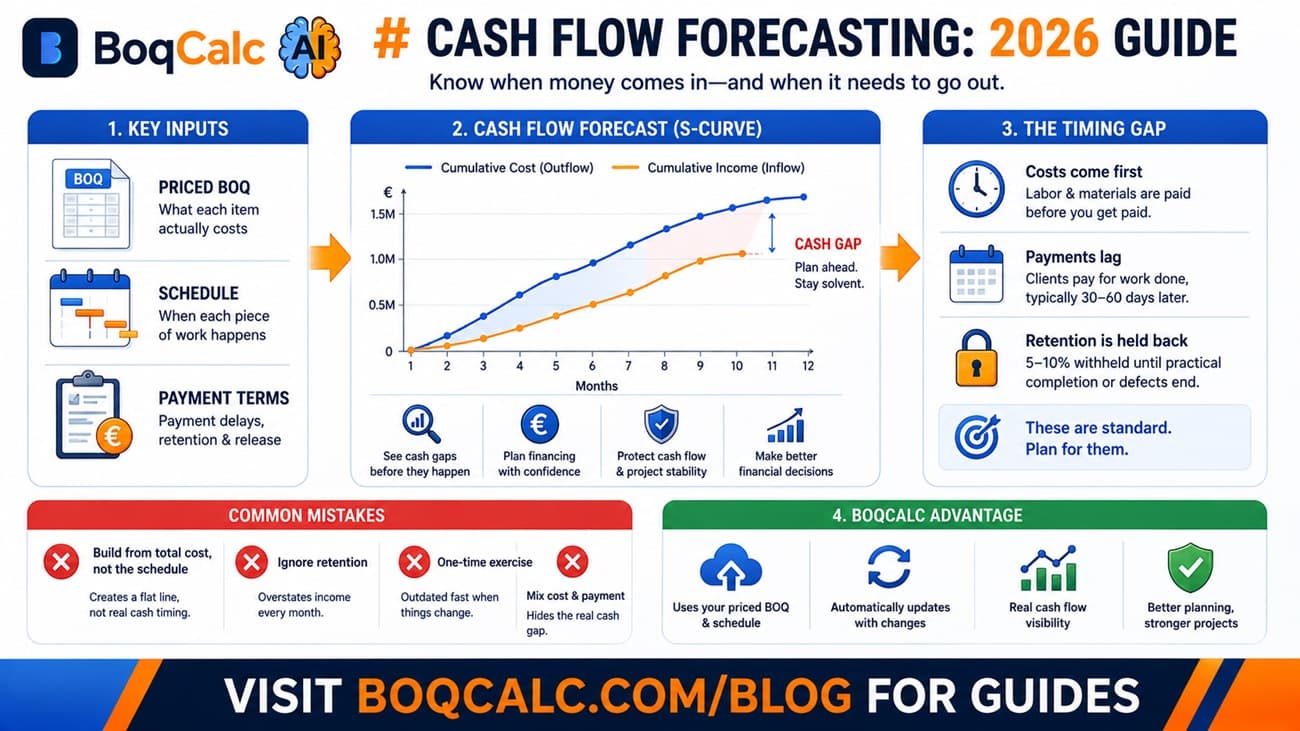
Costs are paid faster than they're invoiced. Labor gets paid weekly or biweekly. Material suppliers often want payment on delivery or short terms. Meanwhile, the client payment for that same work might not arrive for another 30 to 60 days after a valuation is submitted and certified. That gap alone is enough to strain cash on a project with thin working capital.
Retention is real money that isn't available yet. A held-back 5 to 10 percent of every payment isn't lost, but it also isn't available to pay this week's subcontractors. On a large project, retention can represent a meaningful chunk of expected cash sitting in limbo until practical completion or the end of a defects period, sometimes months after the related work finished.
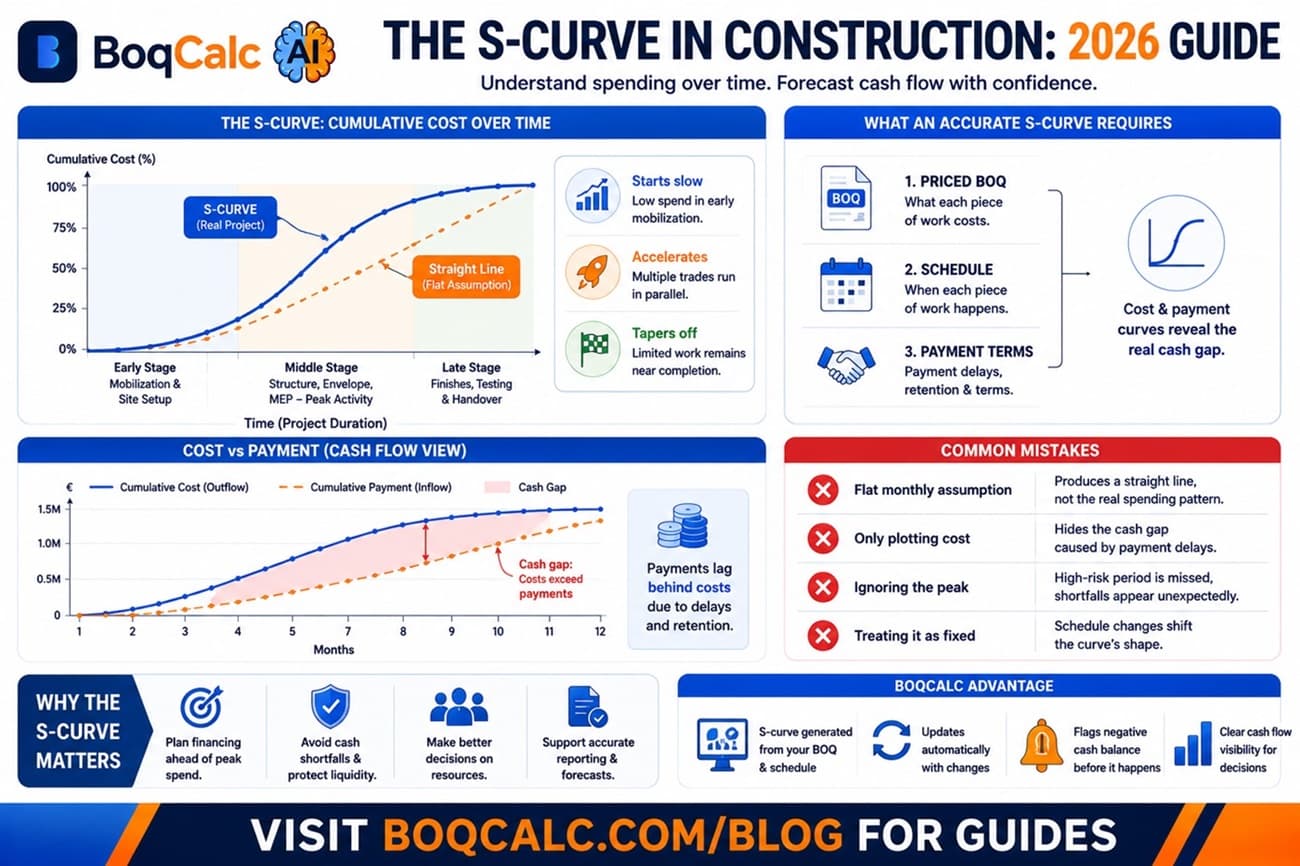
Spending accelerates faster than most people expect. Construction spend follows an S-curve, slow at the start, steep through the middle as trades overlap, tapering at the end. A contractor budgeting on a flat monthly average is consistently underestimating cash need during the steepest part of that curve, exactly when the gap matters most.
Variations get priced without their cash timing considered. A variation might be profitable and get approved, but if it adds cost that lands before the corresponding payment does, it widens the exact gap that was already the problem, even on work that's individually a good deal.
Why This Doesn't Show Up in a Standard Cost Estimate
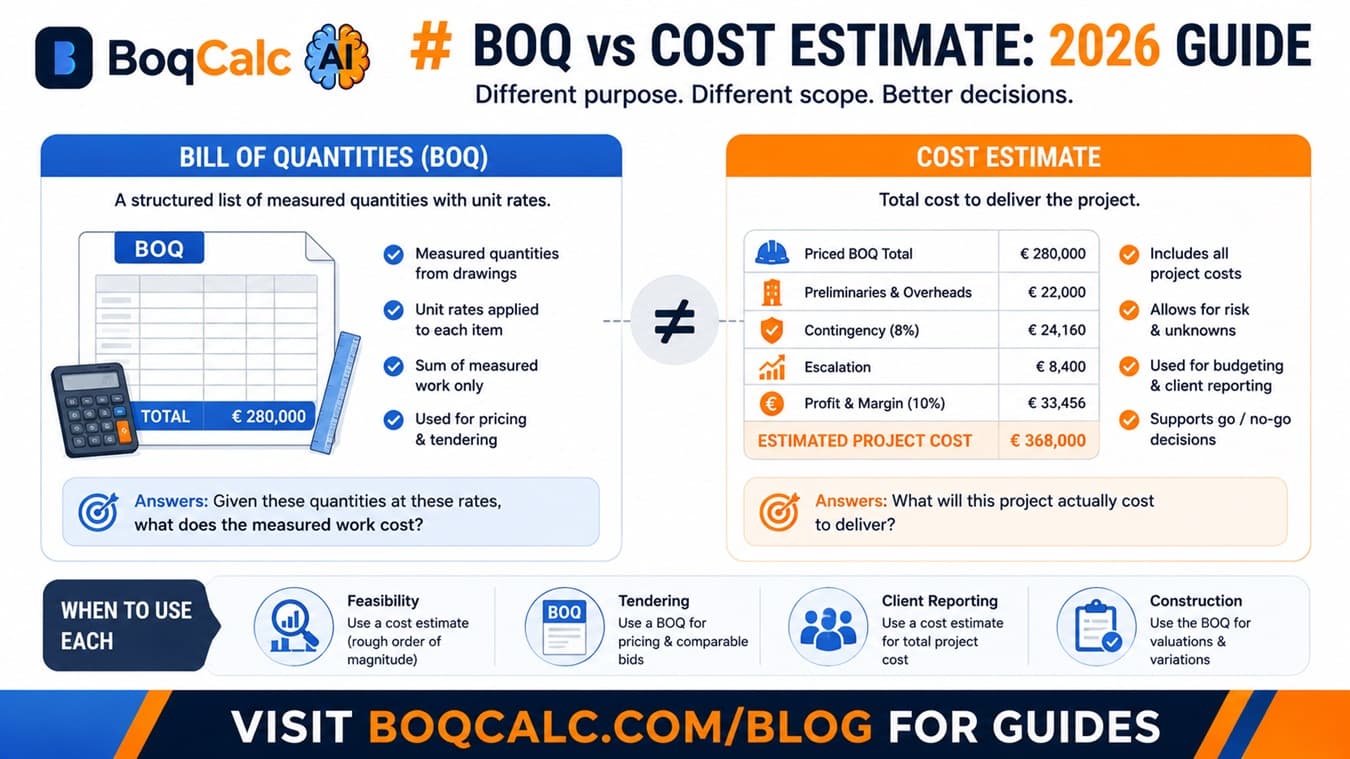
A cost estimate answers what a project costs in total. It says nothing about when that cost needs to be paid relative to when income arrives. Two projects with identical total cost and margin can have completely different cash risk depending entirely on payment terms, retention structure, and how spend is distributed over the schedule. That's a timing question, not a pricing question, and it requires a genuinely separate forecast to see.
What Actually Prevents It
The fix isn't more margin. A project can be underfunded in cash terms regardless of how profitable it is on paper. What actually helps:
- Forecasting cash, not just cost, tied to the actual schedule rather than a flat monthly average, so the timing of the steepest spend is visible in advance.
- Modeling retention explicitly, rather than assuming every payment arrives at full value.
- Negotiating payment terms with the specific cash curve in mind, not as a generic contract clause applied without reference to when this project's spend actually peaks.
- Arranging financing before the gap appears, not after, which is only possible if the forecast flagged the gap early enough to act on it.
For the mechanics of building that forecast properly, see our guide to construction cash flow forecasting and how the cash flow S-curve actually gets its shape from the schedule underneath it.
How BoqCalc Handles This
BoqCalc generates a cash flow projection directly from the same priced BOQ and schedule used for cost estimation, with retention and payment scenarios modeled explicitly rather than assumed. The projection flags where a negative balance is likely before it happens, giving time to arrange financing or renegotiate terms in advance of the gap, not after it's already a problem on site.
Frequently Asked Questions
Can a project be profitable and still fail from a cash perspective? Yes, and it happens more often than the total-cost view of a project would suggest. Profitability and cash solvency are answered by different calculations, and a project can pass one while failing the other.
Is this mostly a problem for smaller contractors? Smaller contractors typically have less working capital buffer, so the same gap hits harder, but the underlying timing mismatch exists on projects of any size. Larger projects just have more absolute cash at stake when it goes wrong.
Does better margin protect against this? Not directly. Margin affects total profitability, not the timing of when cash is needed versus when it arrives. A high-margin project with a bad payment-timing mismatch can still run into a cash shortfall.
What's the earliest point to catch this risk? At tender or pre-construction stage, before committing to payment terms and before the schedule is locked in, since both directly shape the size and timing of the cash gap.
Conclusion
Running out of cash mid-project rarely comes from one obvious mistake. It comes from four ordinary, individually explainable gaps, payment lag, retention, an accelerating spend curve, and unpriced timing on variations, landing at the same point in the schedule. None of them shows up in a total cost estimate. All of them show up in a cash flow forecast built from the actual schedule, which is exactly why that forecast is worth building before the gap becomes a problem instead of after.
BoqCalc Team
From the BoqCalc team
Ready to price your next BOQ?
4 free credits, no credit card. Upload a BOQ and see the cost estimate, risk analysis, schedule, and cash flow for yourself.
Try BoqCalc free →