Construction Cash Flow Forecasting: A Practical Guide
 BoqCalc Team
A priced BOQ tells you what a project costs. It doesn't tell you when you'll need the money to pay for it, and on a project running six months or longer, that timing question is often what actually determines whether a contractor stays solvent, not the total price itself.
What Cash Flow Forecasting Actually Answers
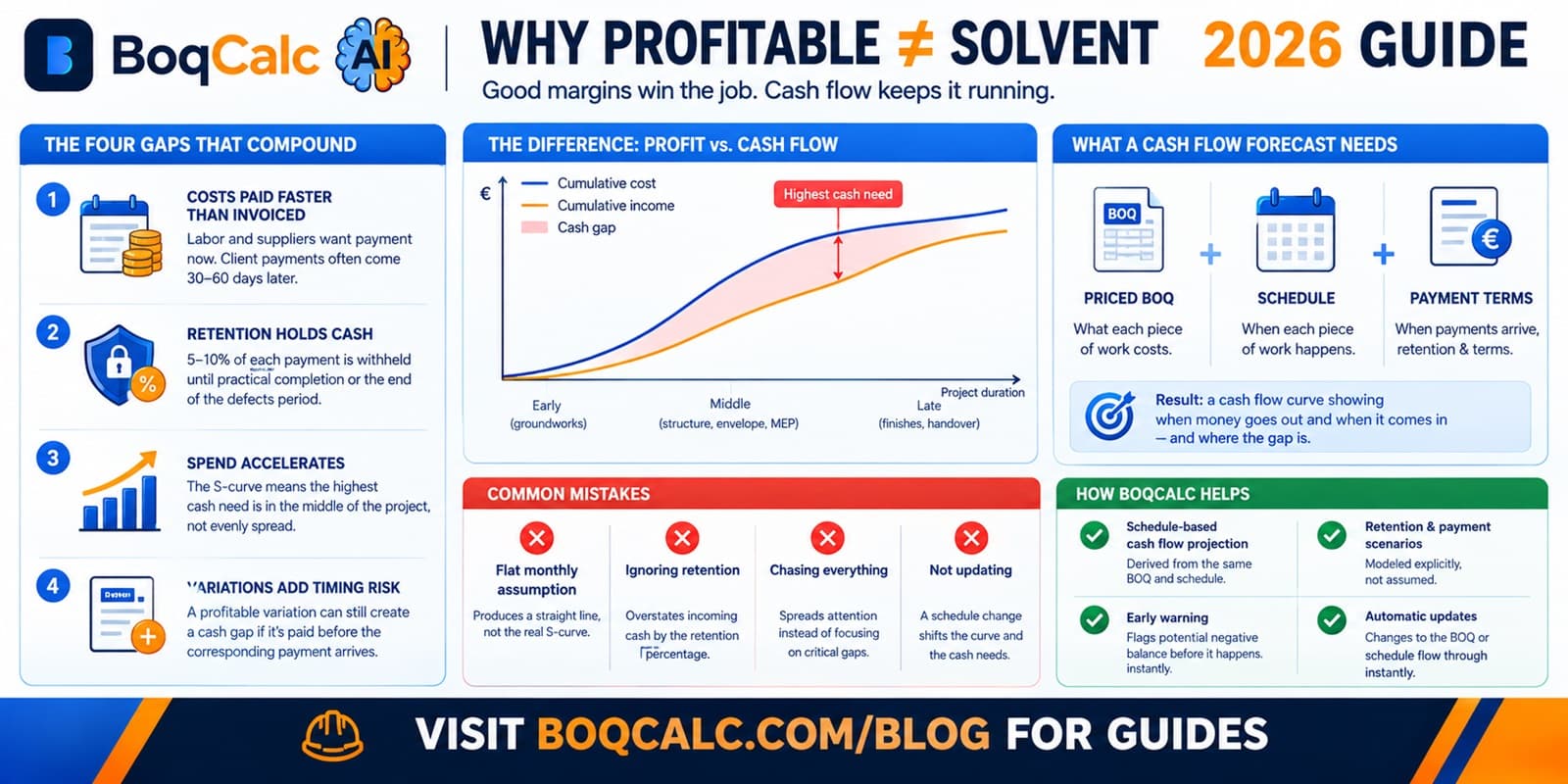
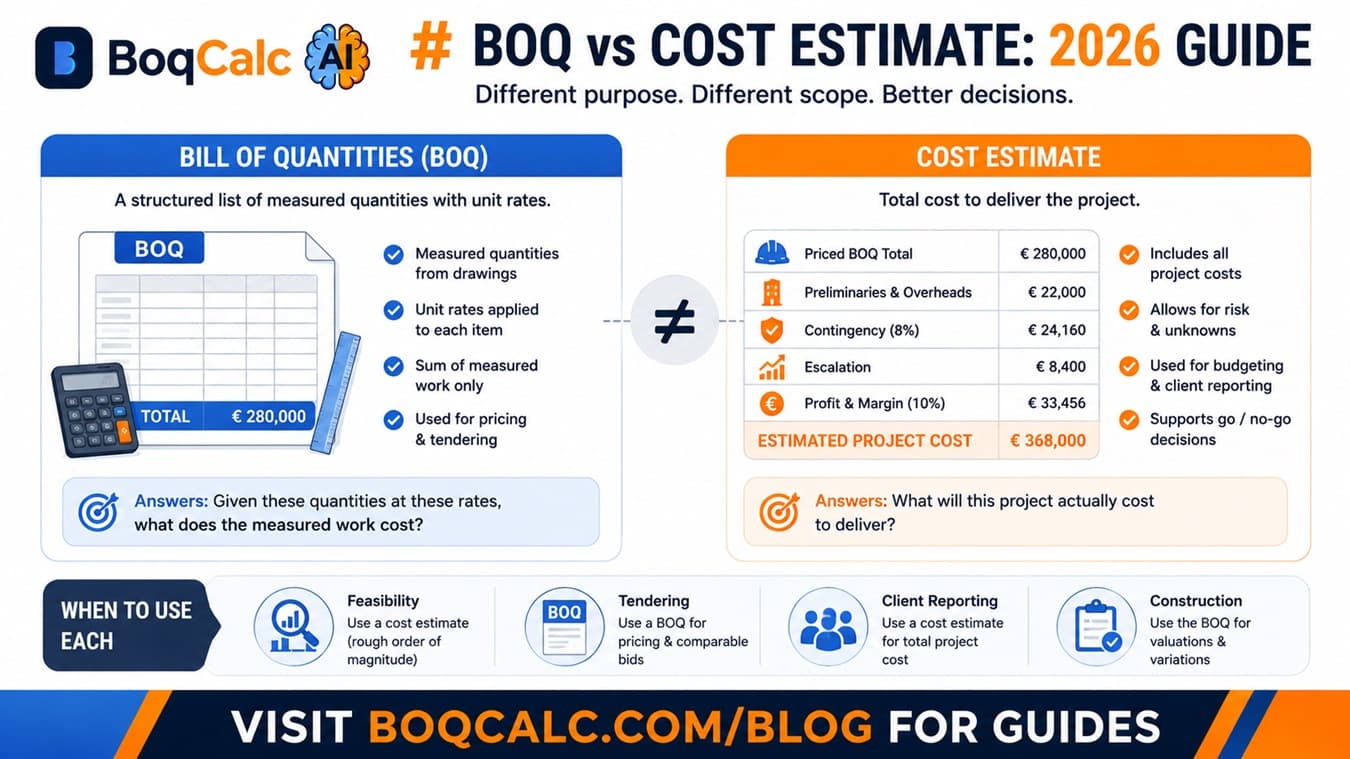
A cost estimate and a cash flow forecast answer different questions. The estimate answers what will this cost in total. The forecast answers how much cash do I need, and when, to keep this project running. A project can be profitable on paper and still run into serious trouble if costs land faster than payments come in.
The Timing Gap That Causes the Problem
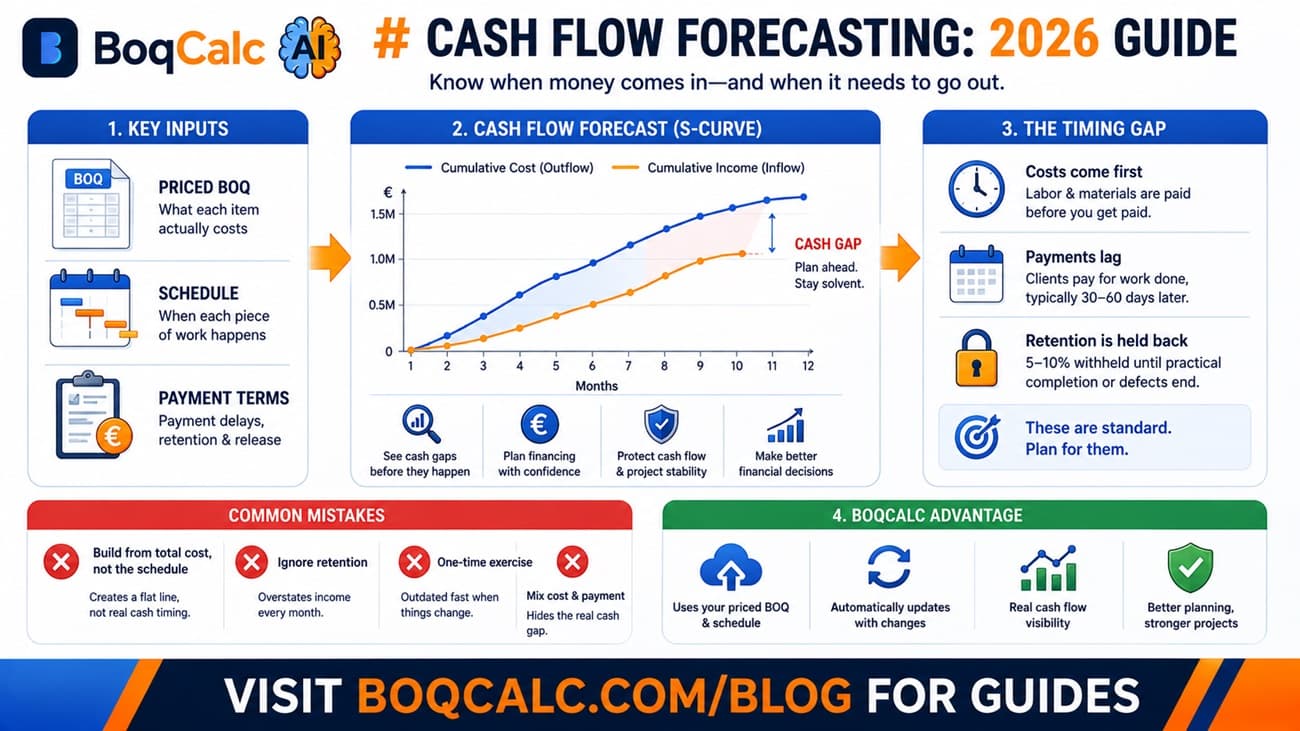
Three timing mismatches show up on almost every project:
- Costs are incurred before they're paid for. Labor and materials get consumed on site well before an invoice is issued or a payment clears.
- Client payments lag behind work completed. Interim valuations and certificates typically pay for work already done, on a delay, often 30-60 days after the work itself.
- Retention gets held back. A percentage of each payment (commonly 5-10%) is withheld until practical completion or the end of a defects period, sometimes months after the related work was finished.
None of these are unusual or avoidable. They're standard practice. The problem isn't that they exist; it's not planning around them.
What a Cash Flow Forecast Actually Needs
A useful forecast is built from three inputs, and it falls apart if any one of them is missing or disconnected from the others:
- The priced BOQ: what each piece of work actually costs.
- The schedule: when each piece of work happens. Without this, there's no way to know when a cost lands, only that it eventually will. See our guide to building a schedule from BOQ quantities for how that timing gets derived in the first place.
- Payment terms: how long after work is completed the payment actually arrives, plus retention percentages and when they're released.
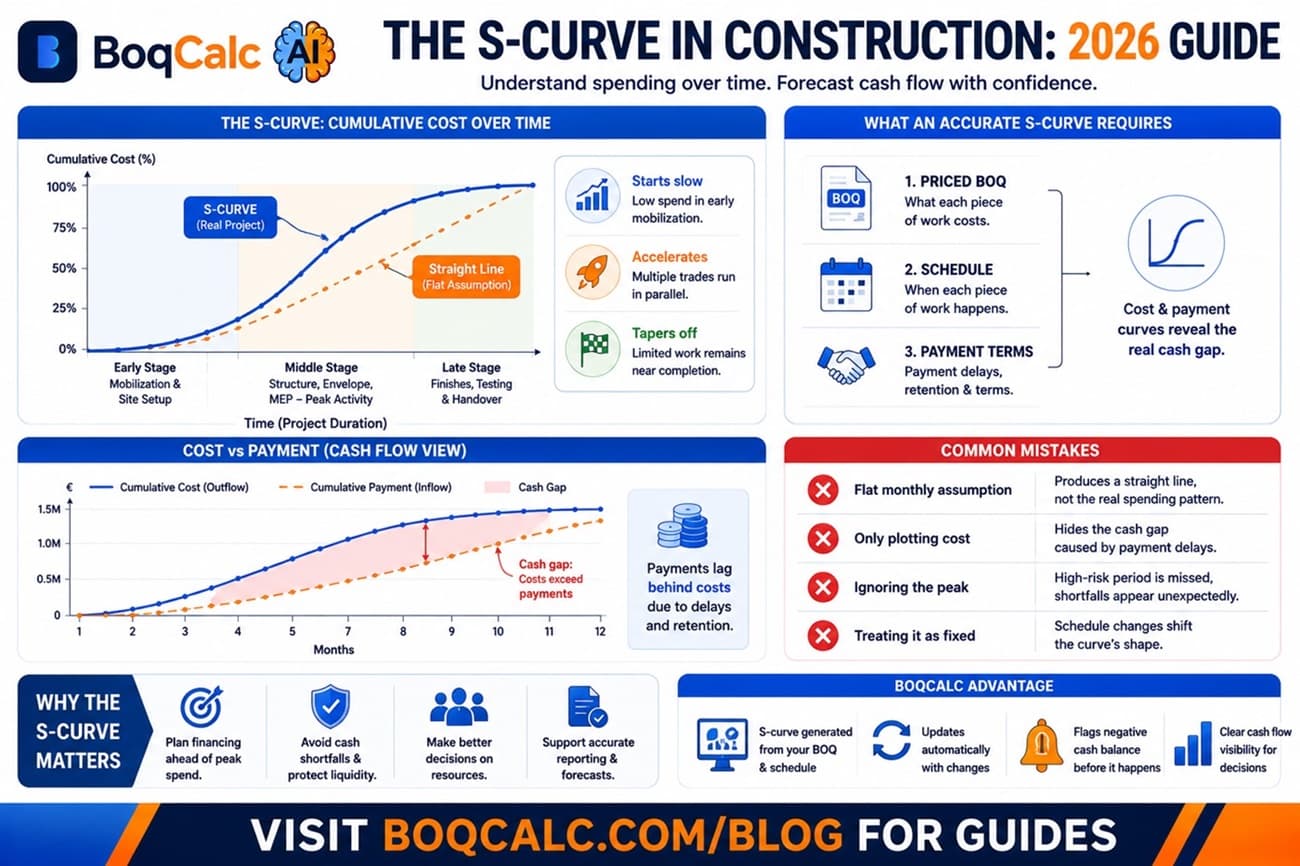
Combine these three and you get a picture of cumulative cost against cumulative income over time, typically visualized as an S-curve, since spending is usually slower at the start and end of a project and heaviest in the middle.
Common Mistakes in Cash Flow Forecasting
Building it from the total cost, not the schedule. Dividing the total project cost evenly across the project duration produces a straight line, not the S-curve that actually reflects how spending happens on real projects, and it misses the specific weeks where a cash shortfall is most likely.
Ignoring retention. A forecast that assumes 100% of each valuation gets paid overstates incoming cash by exactly the retention percentage, every single month, compounding into a meaningfully wrong picture by project end.
Treating it as a one-time exercise. A forecast built at tender stage and never updated stops reflecting reality the moment the schedule shifts or a variation changes the cost profile.
Forecasting cost without forecasting payment timing separately. Cost and payment are two different curves that don't move together: conflating them hides exactly the gap the forecast exists to reveal.
Why This Needs to Connect to the Schedule, Not Just the BOQ
A cash flow forecast built directly from a BOQ total, without reference to an actual schedule, can only ever be a rough average. The real value comes from knowing which specific weeks carry the heaviest spend, usually the structural and envelope stages, so financing can be arranged before that gap shows up, not after. That's only possible when the forecast is derived from the same schedule that sequences the work, not from a flat assumption about how costs are spread over time.
How BoqCalc Handles This
BoqCalc generates a cash flow projection directly from the same priced BOQ and schedule used for cost estimation: the timing comes from when the schedule says each cost actually lands, not from a flat average across the project duration. Because it's derived from the same underlying data, a schedule change flows through to the cash flow projection automatically.
For the estimating step that feeds into this, see our guide to AI BOQ estimation, and for where cash flow fits into the broader cost-control process, see our guide to construction cost management.
Frequently Asked Questions
Is cash flow forecasting the same as budgeting? No. A budget is the total planned cost. A cash flow forecast is about timing: when that cost actually needs to be paid, and when income arrives to cover it.
Why does retention matter so much in a forecast? Because it's real money that's earned but not received for months, often not until well after the related work and its costs are already behind you. Ignoring it overstates available cash at exactly the wrong time.
Can a small project skip cash flow forecasting? For a short, small project with fast payment terms, the timing gap is small enough that it's often not worth a formal forecast. It becomes important as project duration and value grow.
What causes most cash flow problems on construction projects? Usually a mismatch between when subcontractors and suppliers need to be paid and when the client's payment for that same work actually arrives, not the total project cost being wrong.
Conclusion
A project can be priced correctly and still run into a cash crisis if nobody maps out when the money actually needs to move. Cash flow forecasting isn't a nice-to-have add-on to a cost estimate. It's the part of the plan that answers whether you can actually afford to run the project you just priced, on the schedule you're planning to run it.
BoqCalc Team
From the BoqCalc team
Ready to price your next BOQ?
4 free credits, no credit card. Upload a BOQ and see the cost estimate, risk analysis, schedule, and cash flow for yourself.
Try BoqCalc free →