Express vs Full BOQ Analysis: Which Do You Need
 BoqCalc Team
Not every BOQ needs the same depth of pricing. A go/no-go decision on whether to even bid a tender needs a number fast. A final tender submission needs a defensible, per-item breakdown that survives scrutiny. Treating both situations the same way, either over-investing in detail you don't need yet or under-investing when you actually need it, is where a lot of estimating time gets wasted.
What Each Option Actually Delivers
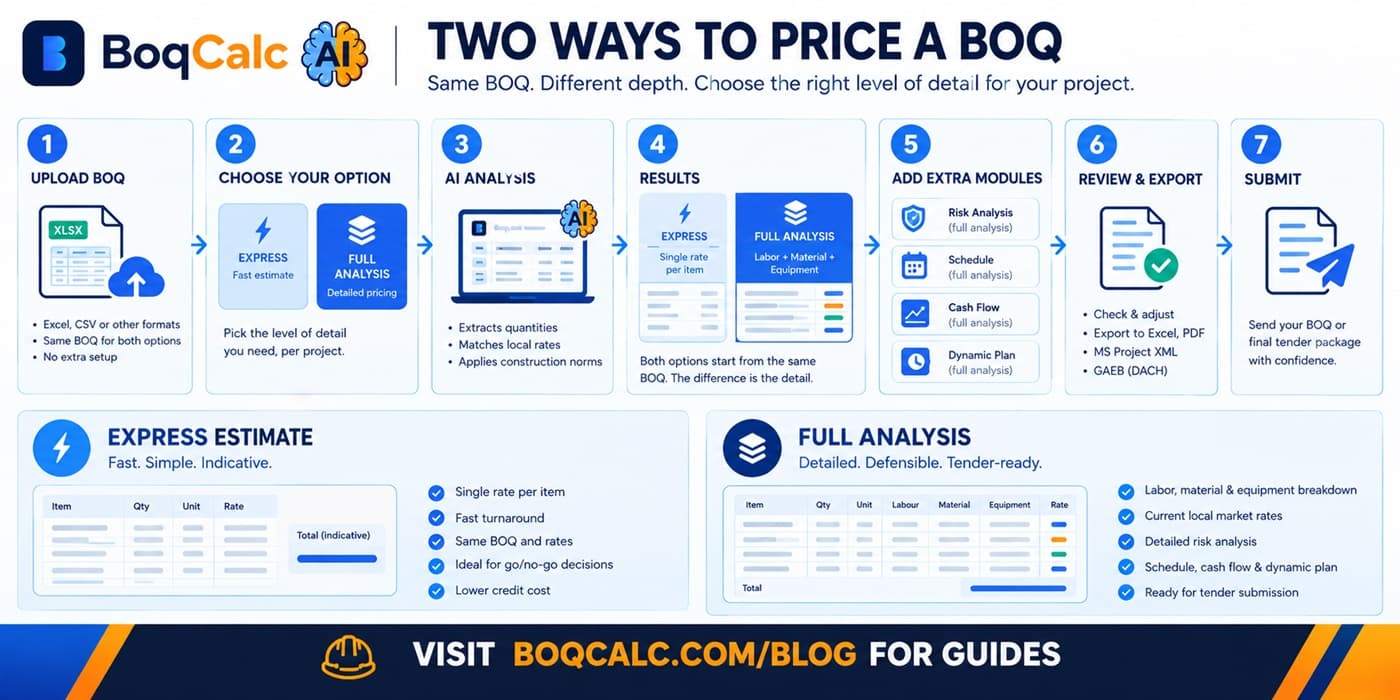
Full analysis prices every BOQ line individually, broken down into labor, material, and equipment, using current local market rates and construction norms. It's the same depth of detail a manual estimator would eventually produce, generated directly from the uploaded BOQ. This is the version you submit as a tender.
Express estimate prices every line too, but as a single indicative rate per item rather than a full labor/material/equipment breakdown. It answers "what does this project cost" without the ten-step detail pass. It's built for speed, not for submission.
Both start from the same uploaded BOQ. The difference isn't what gets read, it's how much detail comes back.
When Express Is the Right Call
Deciding whether to bid at all. Before committing real estimating time to a tender, a fast indicative number answers whether the project is even in a viable price range for your business, without spending a full analysis's worth of time or credits to find out.
Screening multiple opportunities at once. When several tenders land at the same time and estimating capacity is limited, Express lets you triage which ones are worth a full, detailed pass and which aren't close enough to viable to bother with.
Sanity-checking a client's budget expectation. A quick indicative price is often enough to confirm or challenge a client's stated budget before investing in detailed pricing that might turn out to be moot.
When Full Analysis Is Actually Necessary
Any competitive tender submission. A per-item breakdown is what most clients and evaluators expect to receive and be able to scrutinize. An indicative single-rate number generally isn't an acceptable substitute for a formal bid.
Projects where risk analysis depth matters. Full analysis includes the detailed risk pass, flagging specific missing specifications and scope gaps line by line. That level of scrutiny is what actually protects margin on a project with real complexity.
When the schedule or cash flow modules are needed. Both build on the detailed per-item breakdown a full analysis produces. Adding them to an Express estimate means adding the missing detail anyway, so starting with full analysis is usually the more direct path if you already know you need them.
The Cost Difference
Express is priced as a share of what a full analysis costs at the same project value, not as an unrelated cheaper product; it's the same question answered at a coarser resolution. The credit cost scales with detected project value either way. Full detail always costs more credits than Express at the same project size, but Express is never free: it still reflects real AI work, just less of it.
For the exact credit numbers by project value and module, see the machine-readable pricing breakdown or the interactive calculator at boqcalc.com/pricing.
How BoqCalc Handles This
BoqCalc offers both options from the same BOQ upload: Express for a fast, single-rate-per-item estimate, or full analysis for a complete labor, material, and equipment breakdown with detailed risk analysis. You choose per project, so a quick go/no-go screen and a full tender submission can both be handled from the same tool without switching workflows.
For how the full analysis pass works end to end, see our guide to AI BOQ estimation.
Frequently Asked Questions
Can I upgrade an Express estimate to a full analysis later? Yes, since both start from the same uploaded BOQ. If an Express screen confirms a tender is worth pursuing, running the full analysis afterward doesn't require re-uploading anything.
Is Express accurate enough to bid with? It's built for fast, indicative pricing rather than submission-ready detail. For an actual competitive bid, a full analysis is the appropriate choice.
Does Express include risk analysis? Express focuses on speed over per-item depth, so the detailed line-by-line risk flagging that comes with a full analysis isn't part of it. Risk-sensitive projects should go straight to full analysis.
Why not just always run full analysis if it's more thorough? Because thoroughness costs time and credits you don't always need yet. Running full detail on every tender you're only screening, rather than actually pursuing, spends both on projects that may never go anywhere.
Conclusion
Express and full analysis aren't a cheap option and an expensive option. They're two different questions: what does this probably cost, versus what does this definitely cost, broken down and defensible. Picking based on which question you're actually trying to answer, rather than defaulting to one or the other out of habit, is what keeps estimating time and credits spent where they matter.
BoqCalc Team
From the BoqCalc team
Ready to price your next BOQ?
4 free credits, no credit card. Upload a BOQ and see the cost estimate, risk analysis, schedule, and cash flow for yourself.
Try BoqCalc free →