BOQ Price: How to Calculate Accurate Bill of Quantities Pricing for Construction Projects
 BoqCalc Team
Accurate pricing is one of the most important parts of any construction bid.
A small mistake in a single work item can reduce profit margins, create budget overruns, or cause a contractor to underbid an entire project. That is why understanding BOQ price is essential for contractors, estimators, quantity surveyors, and developers.
A Bill of Quantities (BOQ) is not just a list of items and quantities. It is the foundation of project pricing, cost planning, and tender submission. When priced correctly, a BOQ helps contractors submit competitive bids, control project budgets, and reduce financial risk.
In this guide, we explain what BOQ price means, how BOQ pricing works, what affects the cost of a BOQ, and how modern AI tools can improve pricing accuracy.
What Is BOQ Price?
BOQ price refers to the total cost assigned to the items listed in a Bill of Quantities.
A BOQ usually contains:
- Descriptions of work items
- Units of measurement
- Quantities
- Material requirements
- Labor-related scope
- Pricing columns for unit rates and total cost
The BOQ price is calculated by applying a unit rate to each item and summing the total across the project.
For example, if a BOQ includes 500 square meters of plastering and the rate is $12 per square meter, the total price for that BOQ item would be $6,000.
When all items are priced, the result becomes the total BOQ price for the project.
Why BOQ Price Matters in Construction
The BOQ price directly affects the outcome of a construction tender.
If pricing is too low, the contractor risks losing profit. If pricing is too high, the bid may become uncompetitive. Accurate BOQ pricing helps contractors balance competitiveness with profitability.
A well-prepared BOQ price supports:
- More accurate tender submissions
- Better budget forecasting
- Stronger cost control during execution
- Easier comparison between subcontractor bids
- Reduced risk of missing scope items
- Better communication between clients, consultants, and contractors
For many contractors, BOQ pricing is the point where estimating quality directly affects business performance. If your team is exploring faster and more accurate estimating workflows, the main BoqCalc platform is built specifically to automate BOQ analysis, cost estimation, and tender preparation.
What Is Included in a BOQ Price?
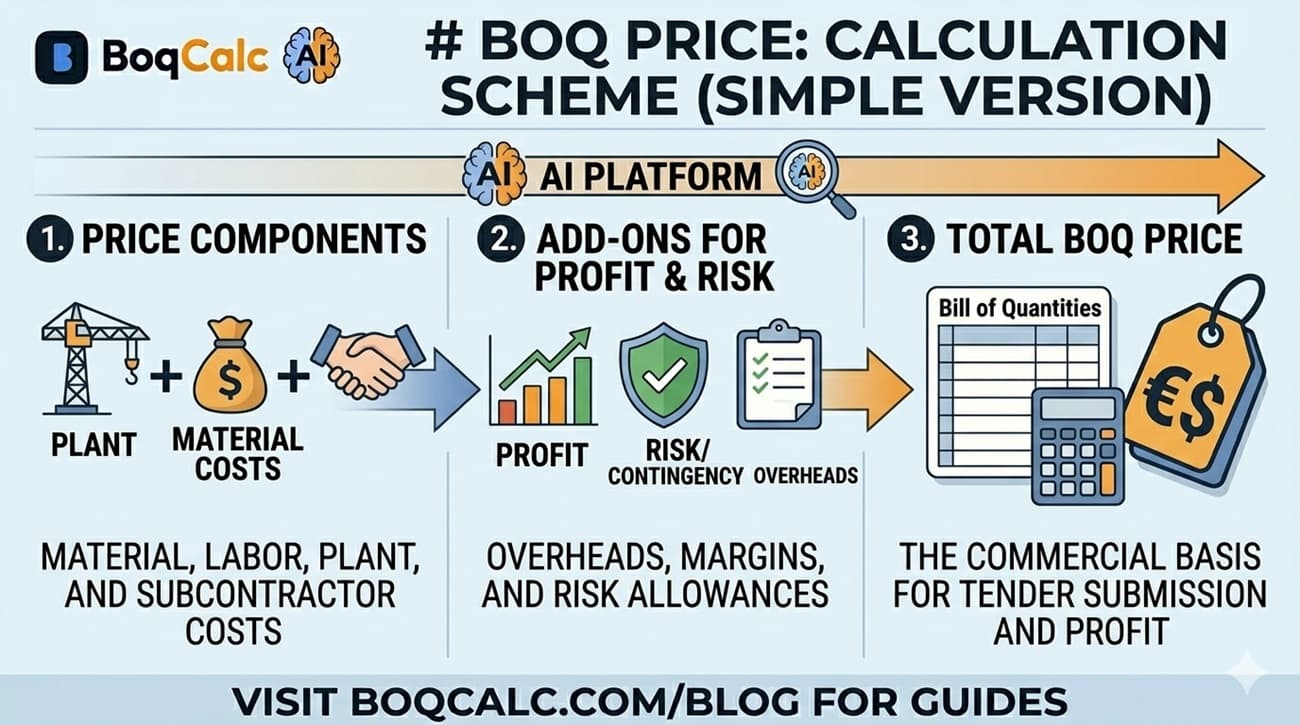
The total BOQ price is usually made up of several cost components.
Material Costs
Material pricing often forms the largest part of the BOQ price. This includes items such as concrete, steel, insulation, finishes, piping, electrical materials, and fixtures.
Labor Costs
Labor pricing includes the workforce needed to complete each item of work. Labor rates vary depending on trade, region, productivity assumptions, and project complexity.
Plant and Equipment
Some BOQ items require machinery, lifting equipment, vehicles, temporary works, or specialist tools. These costs should be included in the relevant unit rates or priced separately where required.
Subcontractor Costs
If parts of the project are subcontracted, their costs must be reflected in the BOQ price structure.
Overheads and Profit
Contractors often add overheads, preliminaries, contingency, and profit margin into the overall BOQ pricing strategy.
Risk Allowances
Some BOQ prices also include a contingency or risk premium for uncertain items, incomplete documentation, or market price volatility.
How to Calculate BOQ Price
Calculating a BOQ price typically follows a structured process.
1. Review the BOQ Structure
Start by reviewing the BOQ carefully.
Check:
- Item descriptions
- Units of measurement
- Quantities
- Work sections
- Specification references
- Drawing references
Before pricing, confirm that the BOQ is complete and aligned with the latest project documents.
2. Verify Quantities
Incorrect quantities lead directly to incorrect pricing.
Common BOQ issues include:
- Missing quantities
- Duplicate items
- Wrong units
- Outdated revisions
- Scope gaps between drawings and BOQ
Quantity verification is essential before final pricing begins.
3. Apply Unit Rates
Each BOQ item needs a unit rate. This rate should reflect the true cost of completing one unit of that item.
Unit rates often include:
- Material cost
- Labor cost
- Plant and equipment
- Waste allowance
- Productivity assumptions
- Overheads and margin
For example:
| BOQ Item | Unit | Quantity | Unit Rate | Total |
|---|---|---|---|---|
| Concrete C30/37 | m³ | 120 | 145 | 17,400 |
| Reinforcement Steel | kg | 18,000 | 1.65 | 29,700 |
| Blockwork | m² | 950 | 42 | 39,900 |
The BOQ price is the sum of all total values across the BOQ.
4. Add Preliminaries and Indirect Costs
Not all project costs appear neatly inside measured BOQ items.
You may also need to include:
- Site setup
- Temporary works
- Site supervision
- Insurance
- Health and safety measures
- Site utilities
- Security
- Project management costs
Depending on the tender structure, these costs may be included as separate BOQ sections or spread across unit rates.
5. Review Risks and Assumptions
A BOQ price should never be prepared without reviewing risk.
Ask questions such as:
- Are there missing details in the specifications?
- Are the quantities reliable?
- Are supplier prices current?
- Are there unrealistic schedule assumptions?
- Does the project include procurement risks or long lead times?
Ignoring these factors can turn a competitive BOQ price into a loss-making contract. That’s why many contractors now combine pricing with structured risk review. Our guide on construction tender risk analysis explains how to identify hidden commercial and technical risks before you submit a bid.
What Affects BOQ Price?
Several factors influence the final BOQ price.
Project Complexity
A simple residential project and a hospital development will not be priced in the same way. More complex projects usually carry higher labor, coordination, and risk costs.
Location
Material costs, labor rates, transportation, and subcontractor pricing vary by market and region.
Design Quality
Poor documentation often increases BOQ price risk because contractors must make assumptions or include contingency allowances.
Procurement Timing
Material price volatility can significantly affect BOQ pricing, especially in steel, MEP systems, finishing packages, and imported products.
Construction Programme
Shorter timelines often require more labor, overtime, temporary resources, and accelerated procurement.
Contract Conditions
Liquidated damages, payment terms, warranty obligations, and retention clauses can all affect how contractors build their BOQ price.
Common BOQ Pricing Mistakes
Even experienced estimators can make mistakes when preparing a BOQ price.
Pricing Without Checking Quantities
If the quantities are wrong, the final BOQ price will be wrong.
Using Outdated Supplier Rates
Old pricing data can distort the estimate and reduce accuracy.
Missing Indirect Costs
Ignoring preliminaries, supervision, logistics, and temporary works leads to underpricing.
Failing to Price Risk
A BOQ price should reflect real project risk, not just base quantities.
Inconsistent Unit Rates
If different estimators use different assumptions across the same BOQ, pricing quality drops and comparison becomes difficult.
BOQ Price vs BOQ Cost
These terms are often used interchangeably, but they are not always the same.
- BOQ cost usually refers to the internal cost of delivering the work.
- BOQ price often refers to the rate submitted in the tender, which may include margin, overhead, and risk allowances.
In practice, contractors use BOQ pricing to convert raw cost information into a market-ready bid.
BOQ Price in Tendering
In most tenders, the BOQ price becomes the commercial basis of the contractor’s offer.
Clients, consultants, and procurement teams use BOQ pricing to compare bids across multiple contractors. That is why pricing clarity, consistency, and structure are so important.
A strong BOQ pricing process helps contractors:
- Respond to tenders faster
- Reduce pricing inconsistencies
- Defend their assumptions more clearly
- Improve margin control
- Standardize estimating across teams
Manual BOQ Pricing vs AI BOQ Pricing
Traditional BOQ pricing is often handled in spreadsheets. While spreadsheets are still common, they create several limitations:
- Slow manual input
- Version control problems
- Repetitive checking
- Limited risk visibility
- Greater chance of human error
AI-powered estimating platforms are changing this process by automating major parts of BOQ analysis and pricing preparation.
How AI Improves BOQ Price Accuracy
Modern AI estimating tools can support BOQ pricing in several ways.
Automated BOQ Analysis
AI can scan BOQ spreadsheets, specifications, and tender documents to identify items, quantities, and missing information.
Faster Quantity Verification
Instead of checking line items manually, teams can use automation to review structure and identify inconsistencies faster.
Smarter Cost Estimation
AI tools can connect BOQ items to historical pricing logic, project patterns, and cost planning workflows.
Better Risk Visibility
Modern systems can highlight missing scope, incomplete specifications, and unusual project risks before the final BOQ price is submitted.
Integrated Workflow
Rather than creating a BOQ in one file and pricing it in another, AI tools can combine:
- BOQ analysis
- Cost estimation
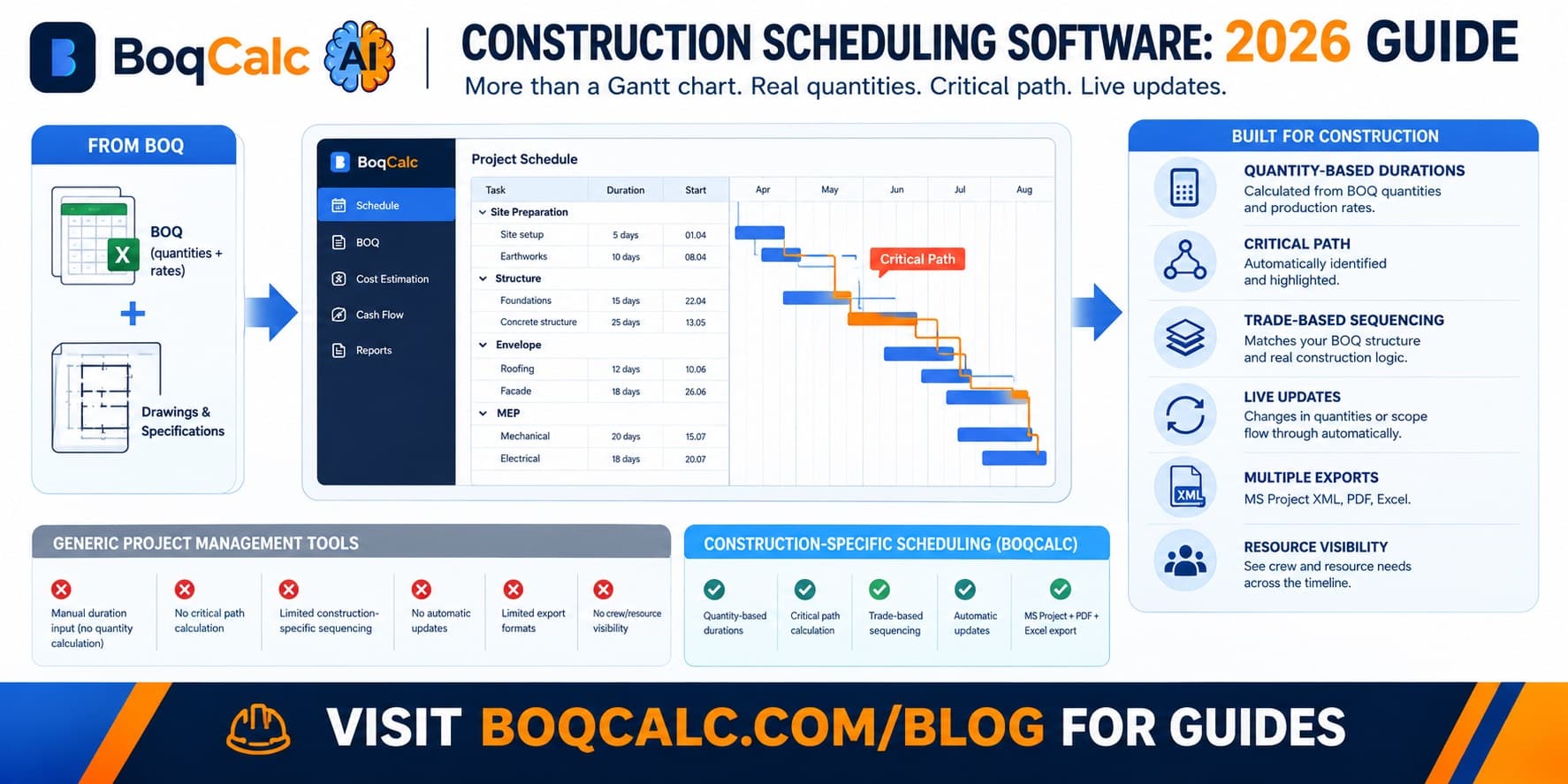
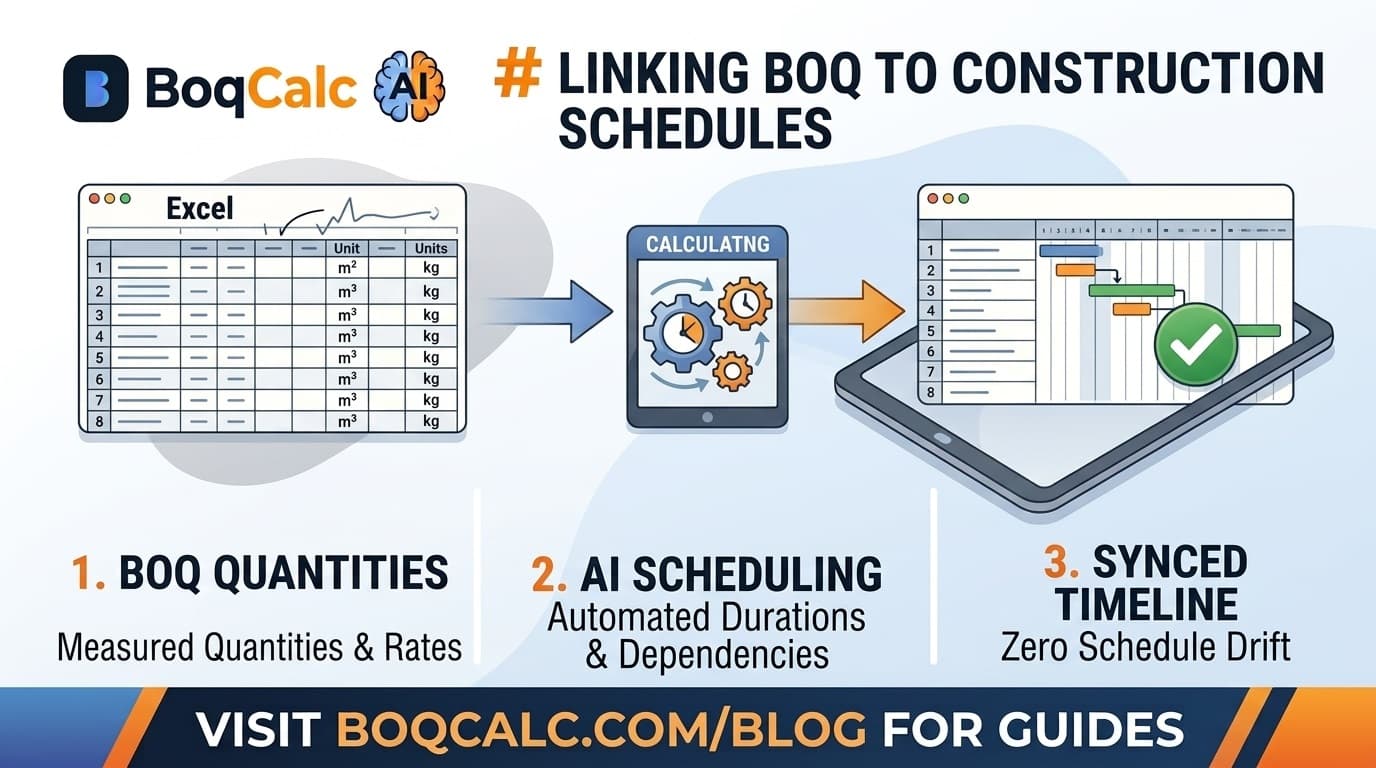
- Schedule generation
- Cash-flow forecasting
- Risk detection
into a single workflow.
For a practical example of what this looks like in real tendering workflows, see how contractors use AI BOQ automation to reduce manual work in our article on AI BOQ estimation and saving 80% of estimating time.
How to Improve Your BOQ Pricing Process
If your team wants to improve BOQ price accuracy, focus on these five areas.
1. Standardize Unit Rate Build-Ups
Create consistent pricing logic for labor, materials, equipment, and margin.
2. Validate Quantities Before Pricing
Never assume the BOQ is correct without checking alignment against drawings and specifications.
3. Use Updated Market Pricing
Refresh supplier and subcontractor rates regularly.
4. Review Commercial Risk
A competitive BOQ price is not only about cost. It must also reflect risk, programme pressure, and contract terms.
5. Automate Repetitive Work
The more repetitive the process, the more value AI and automation can add.
Who Needs Better BOQ Price Control?
BOQ price accuracy matters across the construction industry.
General Contractors
Need competitive but profitable tender pricing.
Quantity Surveyors
Need structured, auditable BOQ pricing workflows.
Developers
Need realistic cost forecasts before project approval.
Subcontractors
Need fast, accurate pricing for specific trade packages.
Consultants
Need pricing consistency across procurement and tender evaluation.
Frequently Asked Questions
What does BOQ price mean?
BOQ price refers to the total priced value of the items listed in a Bill of Quantities, based on quantities, unit rates, and pricing assumptions.
How is BOQ price calculated?
BOQ price is calculated by multiplying each item quantity by its unit rate and summing all items, plus any relevant preliminaries, overheads, risk allowances, and margin.
What is the difference between BOQ price and BOQ cost?
BOQ cost usually refers to the internal cost of delivering the work, while BOQ price often includes markup, overhead, and profit for tender submission.
Why is BOQ pricing important?
Accurate BOQ pricing helps contractors submit competitive bids, reduce estimating errors, control project budgets, and protect profitability.
Can AI improve BOQ pricing?
Yes. AI can help contractors analyze BOQs faster, verify quantities, detect risks, and improve pricing consistency across projects.
Conclusion
Understanding BOQ price is essential for any contractor, estimator, or quantity surveyor involved in construction tendering.
A well-priced BOQ improves bid quality, supports budget control, and reduces the risk of underpricing. But accurate BOQ pricing depends on more than just applying rates to quantities. It requires quantity validation, market-aware pricing, indirect cost planning, and risk review.
As construction estimating becomes more data-driven, companies that modernize their BOQ pricing workflow with automation and AI will be in a much stronger position to bid faster, price more accurately, and protect their margins.
BoqCalc Team
From the BoqCalc team
Ready to price your next BOQ?
4 free credits, no credit card. Upload a BOQ and see the cost estimate, risk analysis, schedule, and cash flow for yourself.
Try BoqCalc free →