Quantity Surveyor Software: What It Needs to Cover Beyond the Tender
 BoqCalc Team
Most "construction estimating software" is built around a single moment: pricing a bid before a contract is signed. A quantity surveyor's job doesn't stop there. It runs the entire length of a project, from an early feasibility figure through to the final account months after handover. Software built only for the bidding moment misses most of what the role actually involves.
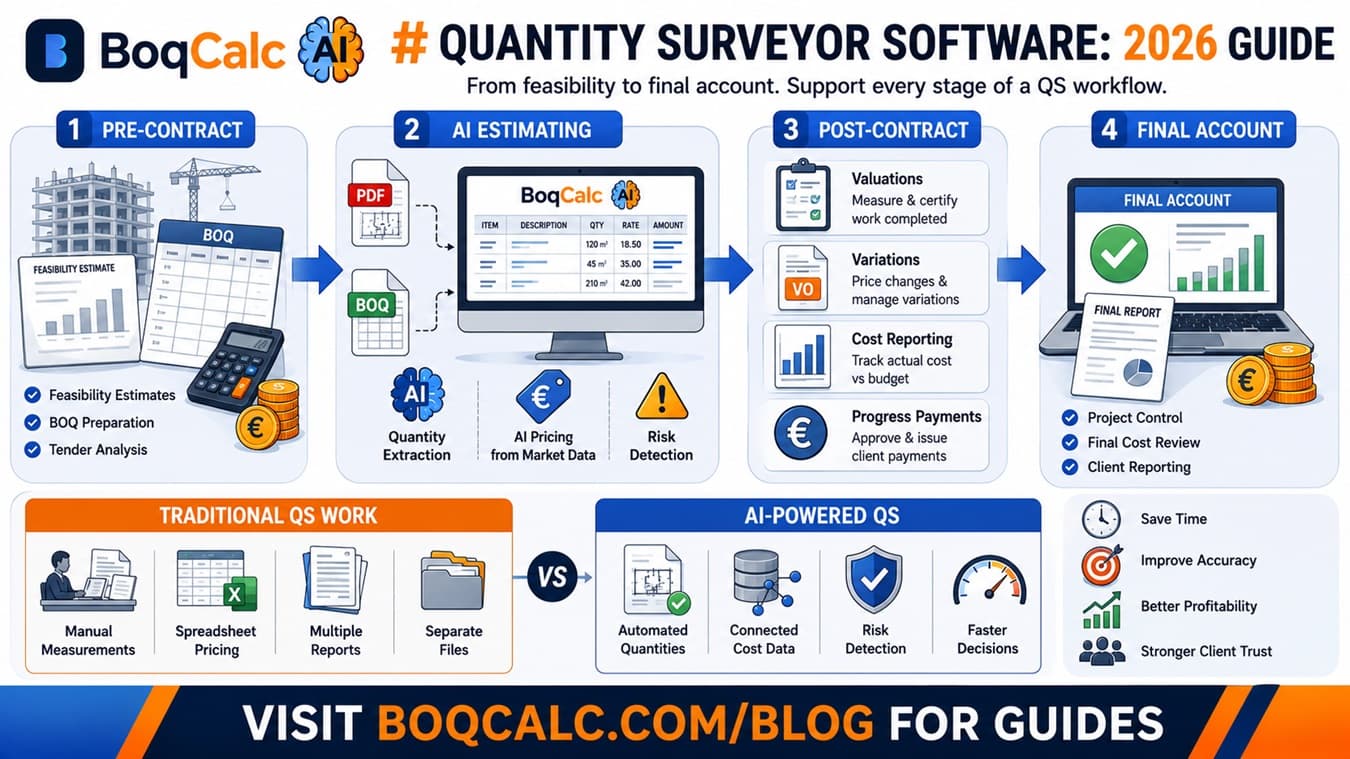
What a Quantity Surveyor Actually Does, Across the Project
It's worth separating the QS role into its two halves, because they need genuinely different things from software:
Pre-contract work:
- Early cost planning and feasibility estimates, often before full drawings exist
- Preparing the Bill of Quantities for tender
- Analyzing returned tenders and comparing contractor bids on a like-for-like basis
Post-contract work:
- Interim valuations: measuring and certifying work completed to date for payment
- Pricing variations as the design changes during construction
- Cost reporting to the client against the original budget, tracking where the project actually stands financially
- Preparing the final account once the project completes
A tool built purely for "price this BOQ faster" addresses the first half well and does almost nothing for the second, which is often where a QS actually spends most of a project's calendar time.
What Quantity Surveyor Software Specifically Needs
Beyond generic estimating features, QS-specific work has requirements that a contractor-focused takeoff tool typically doesn't prioritize:
- Remeasurement support: many contracts (particularly where design isn't fully complete at tender) are priced against estimated quantities and remeasured against as-built work later. Software needs to handle that gap cleanly, not just a single fixed BOQ.
- Variation tracking tied back to the original BOQ: a variation isn't a new line item in isolation; it needs to reference what it's changing relative to the contract sum.
- Cost reporting formatted for a client, not just internal use: a QS's output regularly goes to someone who wasn't involved in building the estimate and needs the number explained, not just totaled.
- Historical rate benchmarking: cost planning at feasibility stage leans heavily on what similar elements cost on past projects, not on measuring drawings that don't exist yet.
A Quick Example: Why Post-Contract Support Actually Matters
Take a mid-project interim valuation. The QS needs to measure work completed against the original BOQ, apply the agreed rates, account for any approved variations since the last valuation, and produce a certified figure the client will actually pay against. None of that is "pricing a BOQ" in the tender sense. It's measuring against a BOQ that already exists, adjusting for what's changed, and producing a number someone else is going to write a check for. Software that only handles the original pricing step has nothing to offer at this stage of the project, even though it's a recurring, monthly piece of a QS's actual workload.
Feature Checklist
When evaluating software specifically for QS work rather than pure contractor bidding, look for:
- Support for both firm-quantity and approximate/remeasurable BOQs
- Variation and change-order tracking linked to the original contract sum
- Elemental/benchmark cost planning for pre-design feasibility stages
- Client-ready cost reports, not just internal pricing sheets
- Multi-stage project support (the same job moves from estimate → tender → contract → final account, ideally in one continuous record)
A tool that only covers the first item on this list is a bidding tool wearing a QS-software label.
How AI Changes the Estimating Side of QS Work
The framing that usually gets applied to contractors ("estimate faster, win more bids") undersells what actually matters for a QS. The real value is different:
Consistency across a large volume of measured items. A QS reviewing a 1,000-line BOQ benefits far more from automated flagging of missing specifications and inconsistent quantities than from raw speed alone. Accuracy under volume is the actual constraint, not typing speed.
Faster, more defensible cost planning at feasibility stage, when there's minimal design detail to work from and the estimate still needs to be credible enough to justify a go/no-go decision.
Freeing up time for judgment work. Automating quantity extraction and pricing suggestions on the estimating side means more of a QS's actual time goes to the parts of the role that genuinely require professional judgment: valuations, variations, and client reporting, rather than to data entry.
Where BoqCalc Fits, Honestly
BoqCalc's strength is the estimating and BOQ-preparation side of this: automated quantity extraction, AI-suggested pricing from local market data, and risk flagging on the documents that feed into a QS's pre-contract work. It's a tool for getting the BOQ and the cost estimate right, not a full post-contract valuation or final-account system, worth knowing upfront rather than discovering the gap mid-project.
For more on how the underlying BOQ automation works, see our guide to AI BOQ estimation.
Frequently Asked Questions
Is quantity surveyor software different from quantity takeoff software? They overlap but aren't the same. Takeoff software focuses on measuring quantities from drawings. QS software needs to support that plus the broader pre- and post-contract workflow: cost planning, variations, valuations, and reporting.
Does AI estimating replace a quantity surveyor's judgment? No. It automates the repetitive measurement and pricing-lookup work, which is a small part of what a QS is actually accountable for. Valuations, variation assessment, and client-facing cost advice still require professional judgment.
What's the biggest gap in most estimating software for QS work specifically? Post-contract support: variations, valuations, and final accounts. Most tools are built around the tender moment and stop there.
Is elemental cost planning the same as BOQ pricing? No. Elemental cost planning happens earlier, often before full drawings exist, and estimates cost per building element (substructure, envelope, services) using benchmarks rather than measured quantities. A BOQ comes later, once there's enough detail to measure.
Conclusion
A quantity surveyor's software needs don't end at the tender submission. The role runs from feasibility through to final account, and tools built only around the bidding moment leave most of that ground uncovered. Getting the estimating and BOQ-preparation stage right with the right tooling frees up time for the parts of the job that actually need a QS's judgment, rather than automating something and calling it done.
BoqCalc Team
From the BoqCalc team
Ready to price your next BOQ?
4 free credits, no credit card. Upload a BOQ and see the cost estimate, risk analysis, schedule, and cash flow for yourself.
Try BoqCalc free →