SMM7 vs NRM2 vs CESMM: Which Method of Measurement Is Your BOQ Using?
 BoqCalc Team
Open a Bill of Quantities from the UK, East Africa, the Gulf, South Asia or much of the Commonwealth, and somewhere in the preambles there will be a line saying which method of measurement it was prepared under. It is easy to skip. It shouldn't be: the method of measurement decides what each item includes, how quantities were calculated, and therefore what your rate needs to cover.
This guide explains the main standards you will meet (SMM7, NRM2, CESMM and POMI), where each is still used, and what changes for the person pricing the BOQ.
What a Method of Measurement Does
A method of measurement is a rulebook shared by whoever measures the BOQ and whoever prices it. It sets out:
- How work is divided into sections and items.
- How quantities are measured: net or gross, which openings are deducted, which units are used.
- What each item is deemed to include: for example, whether formwork, cutting or fixings are measured separately or are included in the rate.
- What must be described in each item so the bidder can price it.
If the BOQ says concrete is measured net with formwork as a separate item, and you price the concrete rate as if it included formwork, you have priced formwork twice. If you assume the opposite, you have priced it zero times. The arithmetic can be perfect and the tender still wrong.
SMM7: The Long-Running UK Standard
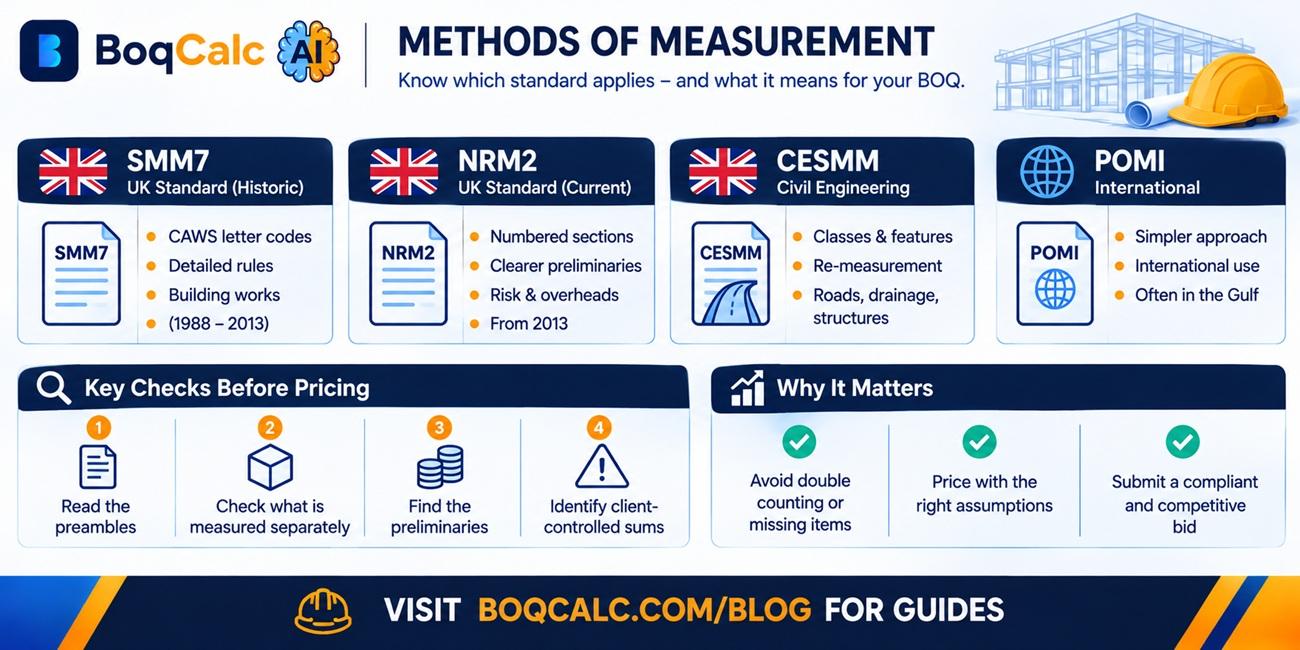
The Standard Method of Measurement of Building Works, 7th edition (SMM7) was published by RICS and the building contractors' federation in 1988 and governed UK building BOQs for about 25 years.
- Work is organised using the Common Arrangement of Work Sections (CAWS), a letter-coded system: for example E for in-situ concrete, F for masonry, M for surface finishes.
- It sets detailed rules for each section on what is measured, in what unit, and what is deemed included.
- It covers building works. Civil engineering works use a different standard (CESMM, below).
SMM7 was formally replaced in the UK by NRM2 in 2013, but it hasn't disappeared. Many BOQs in East Africa, the Middle East, South Asia and other Commonwealth markets are still prepared under SMM7 or local standards derived from it, and plenty of experienced quantity surveyors still think in its terms.
NRM2: The Current UK Standard for Building Works
The RICS New Rules of Measurement are a suite of three documents:
- NRM1: order of cost estimating and cost planning, used at the early design stages.
- NRM2: detailed measurement for building works, the one that produces a tender BOQ.
- NRM3: order of cost estimating and cost planning for building maintenance works.
NRM2 replaced SMM7 for UK building works from 2013. For a bidder, the practical differences include:
- A numbered work-section structure instead of CAWS letter codes.
- More structured treatment of preliminaries, split between main contractor's preliminaries and subcontractors' preliminaries, so they are less likely to be buried inside rates.
- Explicit items for risk, overheads and profit, rather than leaving them entirely to be spread across rates.
- Clearer rules on provisional sums, separating defined and undefined provisional sums, which affects whether you must allow for that work in your programme and preliminaries.
CESMM: Civil Engineering Works
The Civil Engineering Standard Method of Measurement (CESMM), published by the Institution of Civil Engineers and now in its fourth edition, covers roads, bridges, drainage, earthworks, piling, tunnels and similar civil works.
- Work is divided into classes (for example earthworks, in-situ concrete, pipework), and items are described using a structured coding of features within each class.
- Measurement is geared towards remeasurement: quantities are expected to change and be measured again as the work is done, which suits civil works where ground conditions are uncertain.
- Method-related charges allow the contractor to price items such as setting up plant or temporary works separately from the quantities they serve.
If a road or drainage BOQ follows CESMM and you price it like a building BOQ, the method-related charges are where money usually goes missing.
POMI: The International Variant
Principles of Measurement (International), POMI, published by RICS in 1979, was written as a simpler, internationally applicable set of rules. It is still referenced on projects in the Gulf and other international markets, often alongside FIDIC contracts. It is less detailed than SMM7 or NRM2, so more depends on the item descriptions and preambles of each specific BOQ.
Other Standards You Will Meet
Many countries have their own method of measurement, often derived from the British ones:
- India: IS 1200, the Indian Standard method of measurement of building and civil engineering works, alongside public schedules of rates.
- South Africa: the ASAQS Standard System of Measuring Building Work.
- East Africa: regional standard methods derived from SMM, still common on Kenyan and Ugandan tenders.
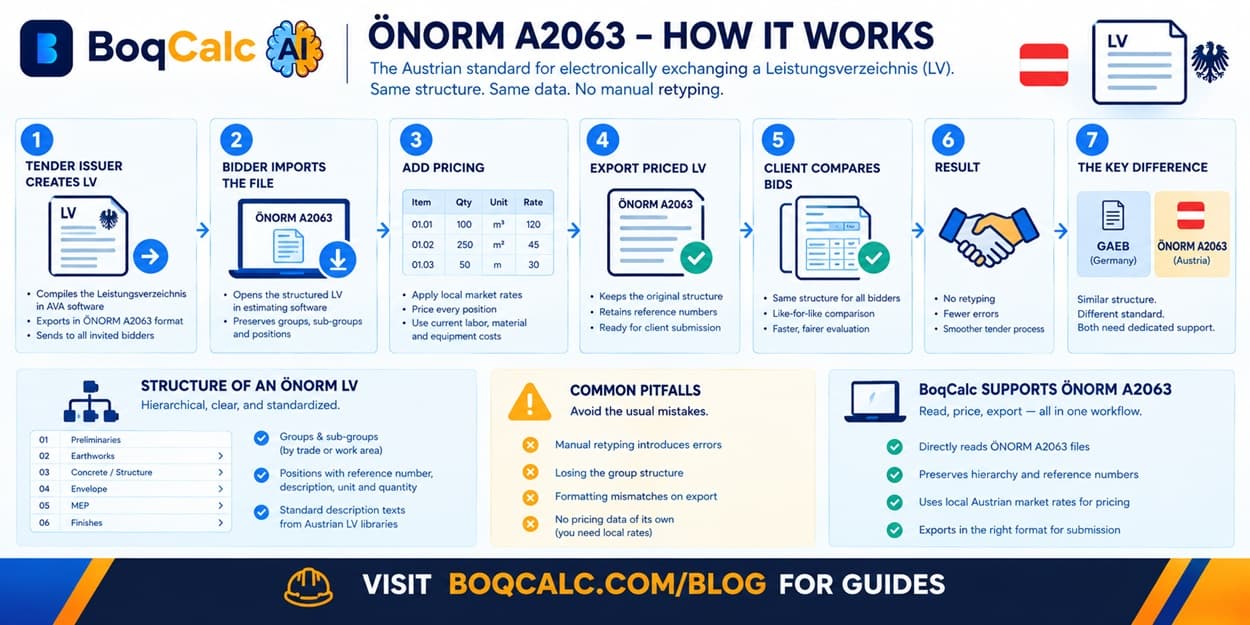
- Germany and Austria: a different tradition entirely, using structured tender formats like GAEB and ÖNORM A2063 with standard description libraries.
What Changes for the Person Pricing
Whatever the standard, the same four checks apply before you start pricing:
- Read the preambles. They state the method of measurement and any amendments to it. The amendments matter as much as the standard itself.
- Check what is measured separately. Formwork, reinforcement, excavation in different materials, disposal and working space are common items that one standard measures separately and another includes.
- Find the preliminaries. Know whether site overheads are priced in a preliminaries section or expected inside your rates, so you don't count them twice.
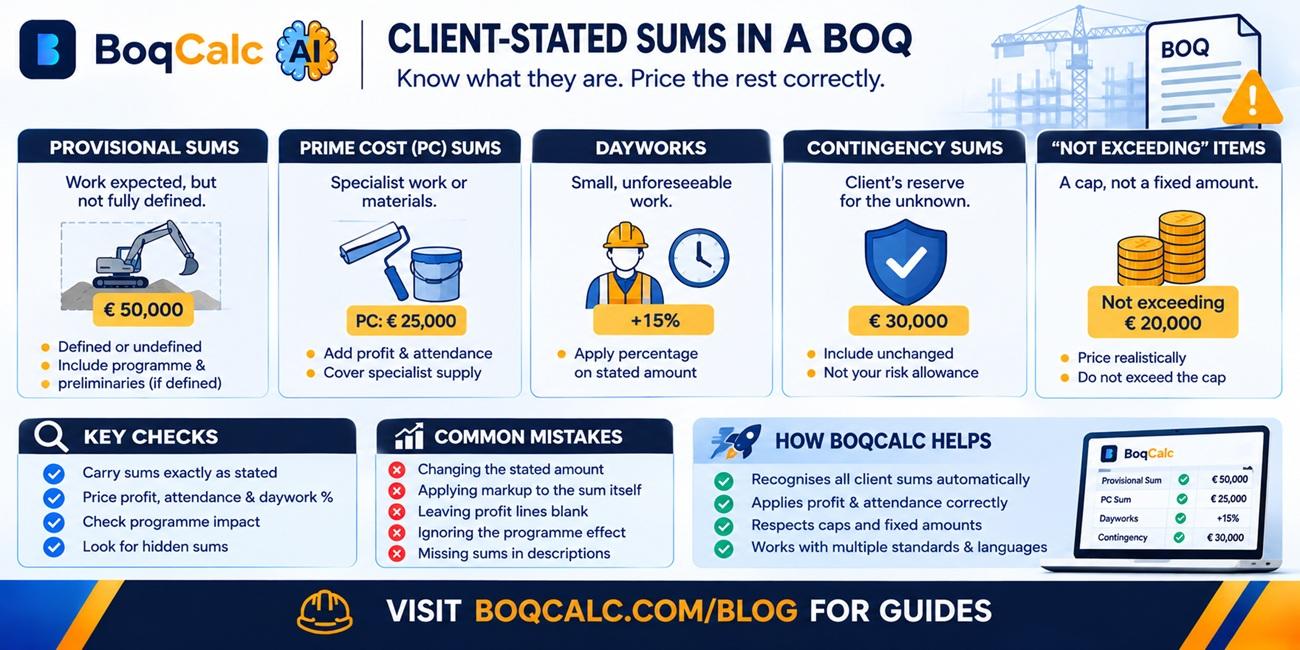
- Identify client-controlled sums. Provisional sums, prime cost sums and dayworks are handled differently from measured work, and each standard has rules on what you must allow for around them.
How BoqCalc Handles Different Standards
BoqCalc doesn't require the BOQ to follow one particular standard. It reads the item descriptions, units and section headings as they are written, so a BOQ prepared under SMM7, NRM2, CESMM, IS 1200 or a local variant is priced line by line in the context of the section it sits in. Client-stated sums such as provisional sums are kept at the figure the BOQ gives rather than re-priced. Prices come from local market data for the project's country, and every line can be reviewed before export.
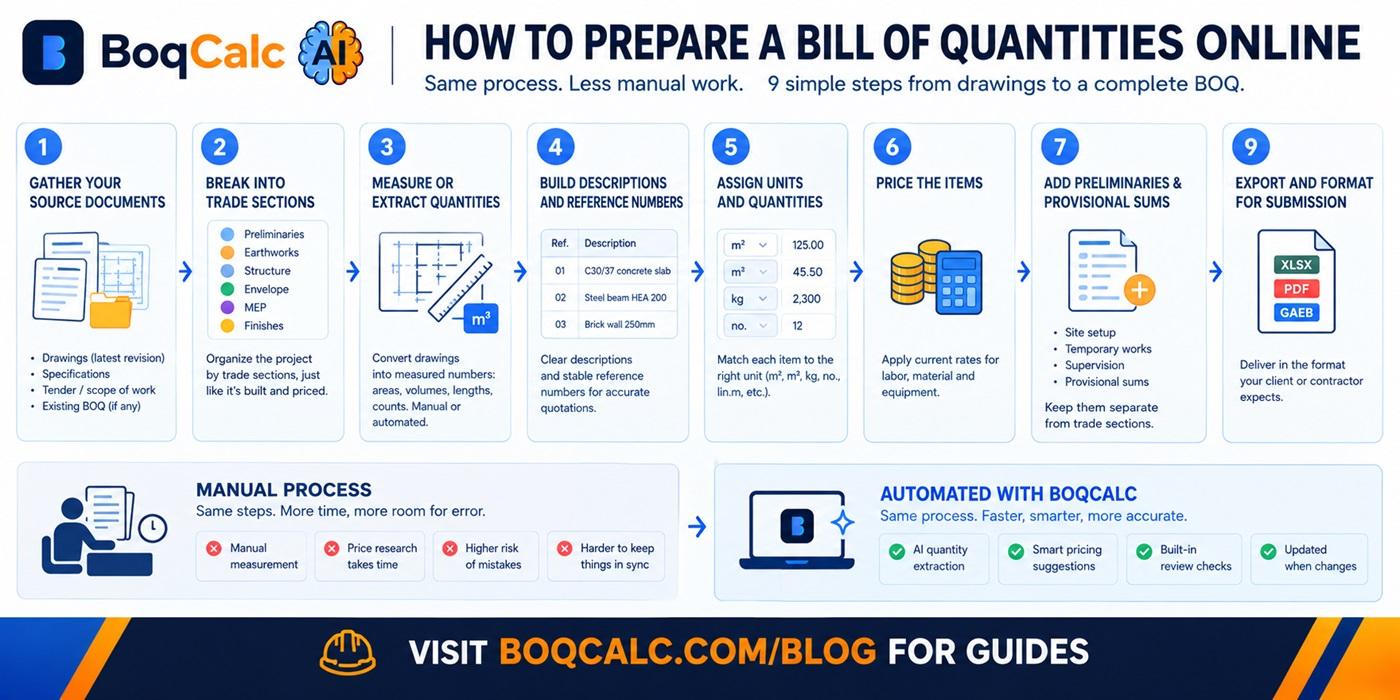
For more on how the BOQ itself is put together, see how to prepare a bill of quantities, and for why a BOQ is not the same thing as an estimate, read BOQ vs cost estimate.
Frequently Asked Questions
Is SMM7 still valid? In the UK it was replaced by NRM2 for building works from 2013. Elsewhere, a BOQ is valid under whatever method its preambles name, and many tenders outside the UK still name SMM7 or a local derivative of it.
What is the difference between NRM1 and NRM2? NRM1 is for cost planning before detailed design exists, using elemental costs and rates. NRM2 is for detailed measurement of a tender BOQ once the design is developed.
Can a project use both NRM2 and CESMM? Yes. A mixed project, such as a building with significant external roads and drainage, may measure the building under NRM2 and the civil works under CESMM. The preambles should say which applies to which section.
Does the method of measurement affect the total price? It affects what each rate must include. Two contractors pricing the same work on different assumptions about what is measured separately will produce different totals, and at least one of them will be wrong.
Conclusion
The method of measurement is the contract between the person who measured the BOQ and the person pricing it. Knowing which one applies, and what it says each item includes, is the difference between a rate that covers the work and one that quietly leaves part of it out.
BoqCalc Team
From the BoqCalc team
Ready to price your next BOQ?
4 free credits, no credit card. Upload a BOQ and see the cost estimate, risk analysis, schedule, and cash flow for yourself.
Try BoqCalc free →