What Is a GAEB File? The Standard Format for German Construction Tenders Explained
 BoqCalc Team
If you've bid on a public construction tender in Germany, Austria, or Switzerland, you've almost certainly received a file ending in .X31, .d81, or .p81 alongside the tender documents. That's a GAEB file, and how well your workflow handles it can decide whether you can bid at all, or whether you're stuck retyping a thousand-line Leistungsverzeichnis by hand.
What GAEB Actually Is
GAEB stands for Gemeinsamer Ausschuss Elektronik im Bauwesen, the joint committee that defines how construction tender data is exchanged electronically across the DACH region (Germany, Austria, Switzerland). It's not a piece of software; it's a data exchange standard, similar in spirit to how PDF is a standard rather than a specific app.
The practical reason it exists: a public authority (or a large private client) prepares a Bill of Quantities (a Leistungsverzeichnis, or LV) in their AVA software, exports it as a GAEB file, and sends it to every contractor invited to bid. Each contractor imports that same file into their own estimating tool, prices every line, and exports it back out as a priced offer. Everyone works from the same structured data instead of retyping a PDF by hand.
The File Types You'll Actually See
GAEB defines several file types depending on which stage of the tender process a file represents. The two generations you'll run into:
Older ASCII format (still common, especially from smaller public bodies):
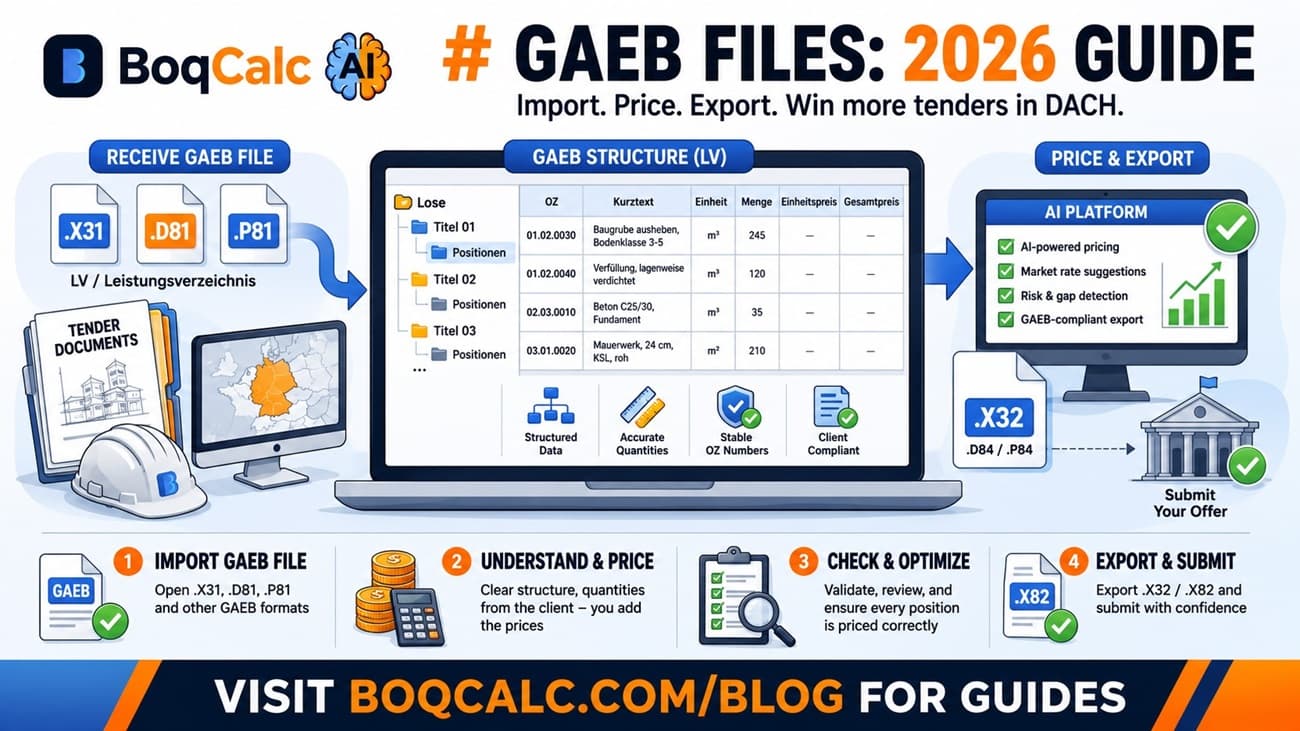
.X31/.d81/.p81: the Leistungsverzeichnis (LV) sent out to bidders, unpriced.X32/.d84/.p84: your priced offer, sent back.X33: a price comparison file, used internally by the client.X34: the awarded contract
GAEB DA XML (the current standard, replacing the ASCII format):
.X81: LV.X82: priced offer.X83: price comparison.X84: award/contract.X85/.X86: measurement and invoicing stages later in the project
You don't need to memorize all of these. In practice, what matters is: you'll receive an .X31 or .X81, and you need to send back an .X32 or .X82 with your prices filled in.
How a GAEB LV Is Structured
A GAEB Leistungsverzeichnis isn't a flat list. It's hierarchical, and understanding that hierarchy is what makes a thousand-line tender navigable instead of overwhelming:
- Lose (lots): for large tenders split into multiple contracts
- Titel (sections): trade or work-area groupings, e.g. "Erdarbeiten" (earthworks) or "Rohbau" (shell construction)
- Positionen (line items): the individual priceable items, each with an Ordnungszahl (OZ, a structured reference number like
01.02.0030), a short text, a full text description, unit, and quantity
Every position in the file already carries its quantity: the client's side has done the measuring. Your job as the bidder is exclusively to fill in unit rates, not to re-measure anything, which is a meaningfully different workflow than pricing a BOQ you built yourself from drawings.
A single position, simplified, looks roughly like this:
| OZ | Kurztext | Einheit | Menge | Einheitspreis | Gesamtpreis |
|---|---|---|---|---|---|
| 01.02.0030 | Baugrube ausheben, Bodenklasse 3-5 | m³ | 245 | (to be priced) | (calculated) |
The OZ ties that exact row back to the client's own system. Renumbering it, splitting it, or reformatting the text, even slightly, is what causes a submitted offer to fail automated validation on the client's side before a human ever reviews the price.
Why This Matters More in Germany Than It Might Look
Public procurement in Germany (governed by VOB/A, the construction procurement regulation) has pushed GAEB adoption hard for years, and many public tenders now expect or require electronic submission in GAEB format rather than a printed or freely-formatted offer. That means GAEB fluency isn't optional for a contractor who wants to bid on public infrastructure, school, or municipal building work in the DACH region; it's table stakes.
Private clients using professional AVA (Ausschreibung, Vergabe, Abrechnung) software have largely followed the same convention, since it's the format their tools already produce.
Where This Breaks Down Without the Right Tooling
The problems contractors run into with GAEB aren't really about understanding the standard. They're about what happens next:
- Manual retyping. Without a GAEB-aware tool, a 600-position LV gets manually copied into a spreadsheet, position by position, introducing exactly the kind of transcription errors a structured format was supposed to prevent.
- Losing the hierarchy. A flat export loses the Titel grouping, making it much harder to sanity-check pricing by trade section before submission.
- Round-trip formatting errors. The priced file you send back has to validate against the same GAEB structure the client's system expects, and a malformed export can get an otherwise-competitive bid rejected on a technicality before anyone even reads the price.
- No pricing intelligence. The GAEB file gives you quantities and descriptions, not prices. You still need current, local labor and material rates for every one of those positions: the standard solves data exchange, not estimation.
How BoqCalc Handles GAEB
BoqCalc reads GAEB files (.X31/.X81 and the related formats) directly, preserving the Lose/Titel/Position hierarchy instead of flattening it, and suggests pricing for every position using local market data. The output exports back out in a structure ready for submission, with the same reference numbers and structure the client's system sent, with no manual re-keying and no risk of the OZ numbering drifting out of sync with the original tender.
For how the pricing step itself works once quantities are in place, see our guide to AI BOQ estimation.
Frequently Asked Questions
Do I need special software to open a GAEB file? Standard AVA/estimating software that supports GAEB import can open it. A generic spreadsheet program can't parse the structure correctly: you'd be working with raw, unformatted data instead of the intended hierarchy.
What's the difference between GAEB 90 and GAEB DA XML?
GAEB 90 is the older ASCII-based format (.X31, .X32, etc.). GAEB DA XML is the current XML-based standard (.X81, .X82, etc.), designed to be more reliable and easier to validate. Both are still in active use, and which one you receive depends on the client's own software.
Is GAEB only used in Germany? It's most heavily used in Germany, but it's also standard in Austria and Switzerland, and occasionally appears in cross-border DACH tenders.
Can I submit my offer in a different format if I received a GAEB LV? Technically sometimes, but it usually defeats the purpose from the client's side and can put you at a disadvantage, since many evaluators compare bids using automated tools that expect the GAEB structure back.
Conclusion
GAEB isn't a complicated standard once you know its shape: a hierarchical LV with quantities the client already measured, positions you price, and a file format built for round-tripping without transcription errors. The real cost shows up when a contractor's tooling doesn't speak GAEB natively: hours of manual re-entry on every tender, and real risk of a formatting mistake costing a bid that was priced competitively. For anyone bidding regularly in the DACH region, GAEB support in your estimating workflow isn't a nice-to-have feature. It's the difference between bidding on public work at all and sitting those tenders out.
BoqCalc Team
From the BoqCalc team
Ready to price your next BOQ?
4 free credits, no credit card. Upload a BOQ and see the cost estimate, risk analysis, schedule, and cash flow for yourself.
Try BoqCalc free →