Critical Path Method Explained for Contractors
 BoqCalc Team
Most of a construction schedule can slip a little without changing the finish date. One sequence of tasks cannot. That sequence is the critical path, and knowing which trades sit on it, rather than treating every delay as equally urgent, is what separates a schedule that protects the finish date from one that just looks organized.
What the Critical Path Actually Is
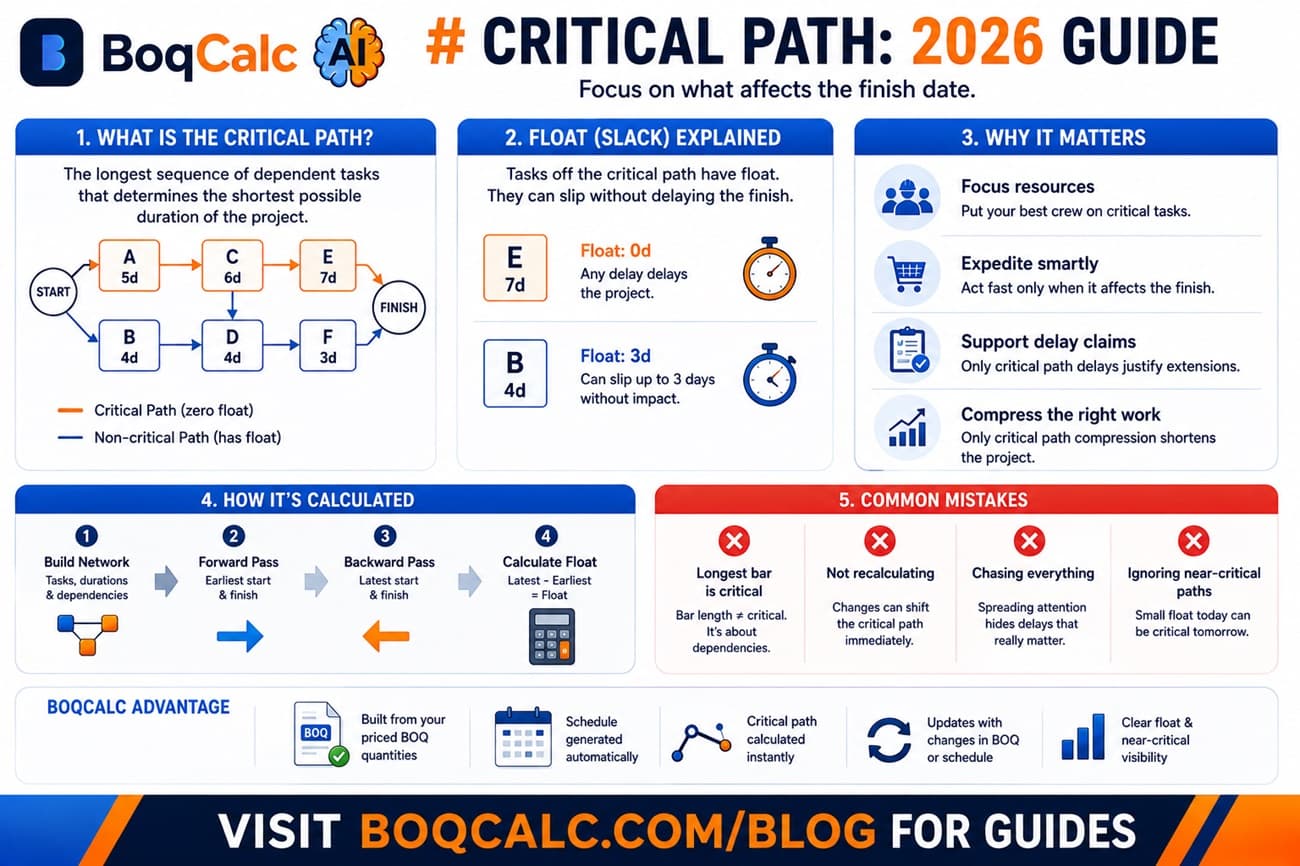
Every schedule is a network of tasks with dependencies: some tasks cannot start until others finish, some can run in parallel. Add up the longest chain of dependent tasks from project start to project finish, and that chain is the critical path. Its total duration is the minimum possible time the project can take.
Every other task has float (sometimes called slack): the amount it can be delayed without pushing the finish date. A task with two weeks of float can slip by up to two weeks and the project still finishes on time. A task on the critical path has zero float. Any delay there is a direct, day-for-day delay to the whole project.
Why This Matters More Than It Sounds Like It Should
The practical value isn't academic. It changes what a contractor actually does with limited attention and resources:
- Where to put your best crew. A skilled crew on a critical-path task protects the finish date. The same crew on a task with three weeks of float is arguably wasted there.
- What to expedite when a supplier is late. A material delay on a non-critical task is an annoyance. The same delay on a critical-path task threatens the completion date directly.
- What justifies a claim for extension of time. A delay caused by the client or a third party is only a defensible basis for an extension if it actually affected the critical path. Delaying a task with float, even significantly, usually isn't.
- Where a schedule compression effort should focus. Trying to finish early by compressing tasks that aren't on the critical path doesn't move the finish date at all. Only critical-path compression does.
How the Critical Path Is Actually Calculated
The calculation itself is mechanical once the dependency network exists:
- Build the dependency network. Every task, its duration, and what it depends on before it can start.
- Forward pass. Starting from project start, calculate the earliest possible start and finish for every task, respecting dependencies.
- Backward pass. Starting from the calculated project finish, work backward to find the latest each task can start or finish without delaying that finish date.
- Calculate float. The gap between a task's earliest and latest start (or finish) is its float. Zero float means the task is on the critical path.
Done by hand on a spreadsheet, this is realistic for a small schedule and increasingly error-prone as task count grows. A missed dependency or a duration typo doesn't just shift one task, it can silently change which path is actually critical without anyone noticing.
Common Mistakes
Assuming the longest-looking bar on the Gantt chart is the critical path. Visually long tasks aren't necessarily critical if they have float. The critical path is a calculated property of the dependency network, not something visible from bar length alone.
Not recalculating after a schedule change. A single duration change, or a new dependency introduced by a variation, can shift which tasks are critical. A critical path calculated once at tender stage and never revisited stops being accurate the moment the schedule changes.
Treating every trade as equally urgent. Without knowing the critical path, it's tempting to chase every delay with equal urgency. That spreads limited management attention across tasks that mostly don't need it, while genuinely critical delays get the same response as everything else.
Ignoring near-critical paths. A path with just a few days of float is often one small delay away from becoming critical itself. A critical path analysis that only flags zero-float tasks misses these until it's too late to react.
How BoqCalc Handles This
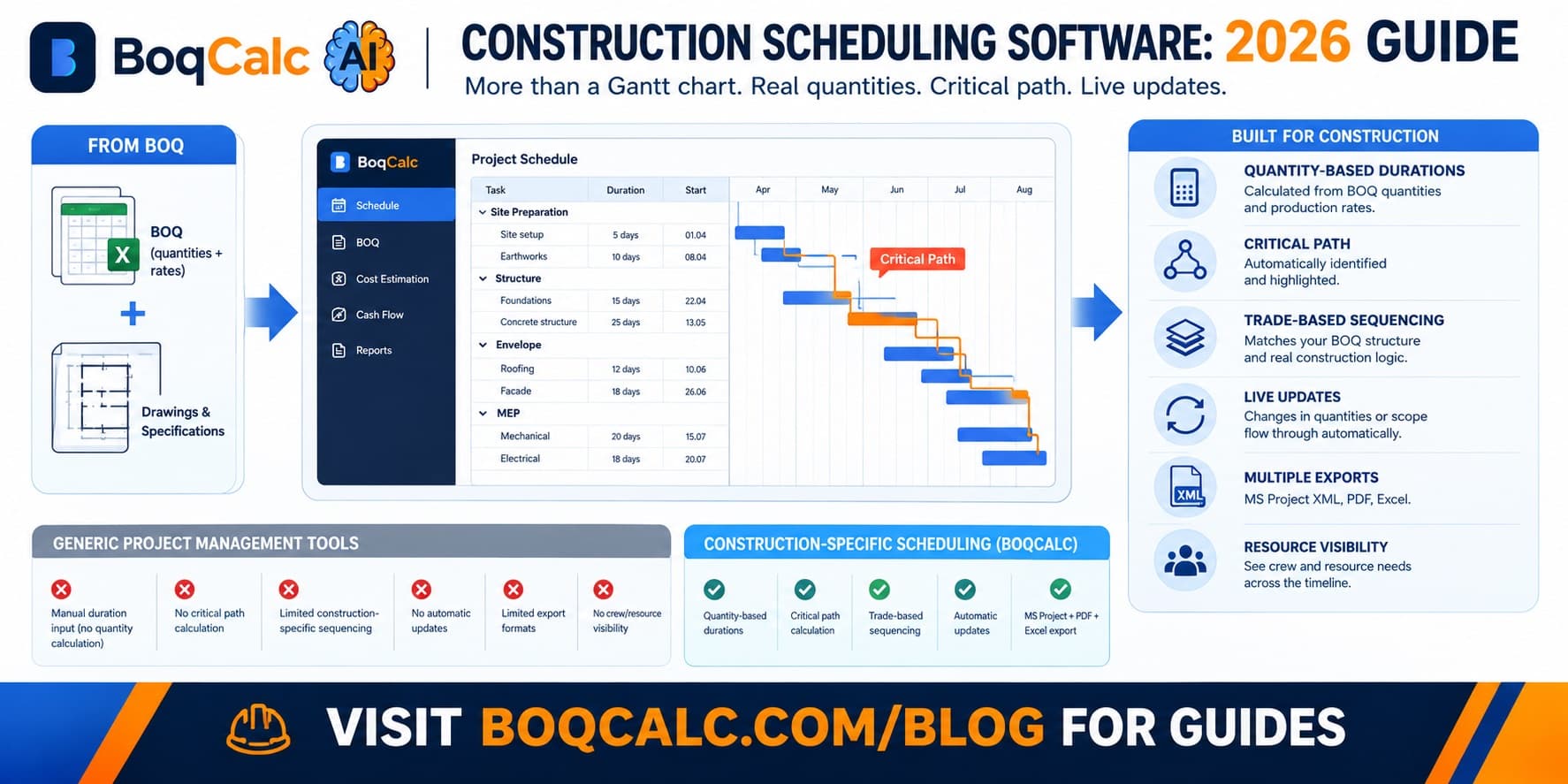
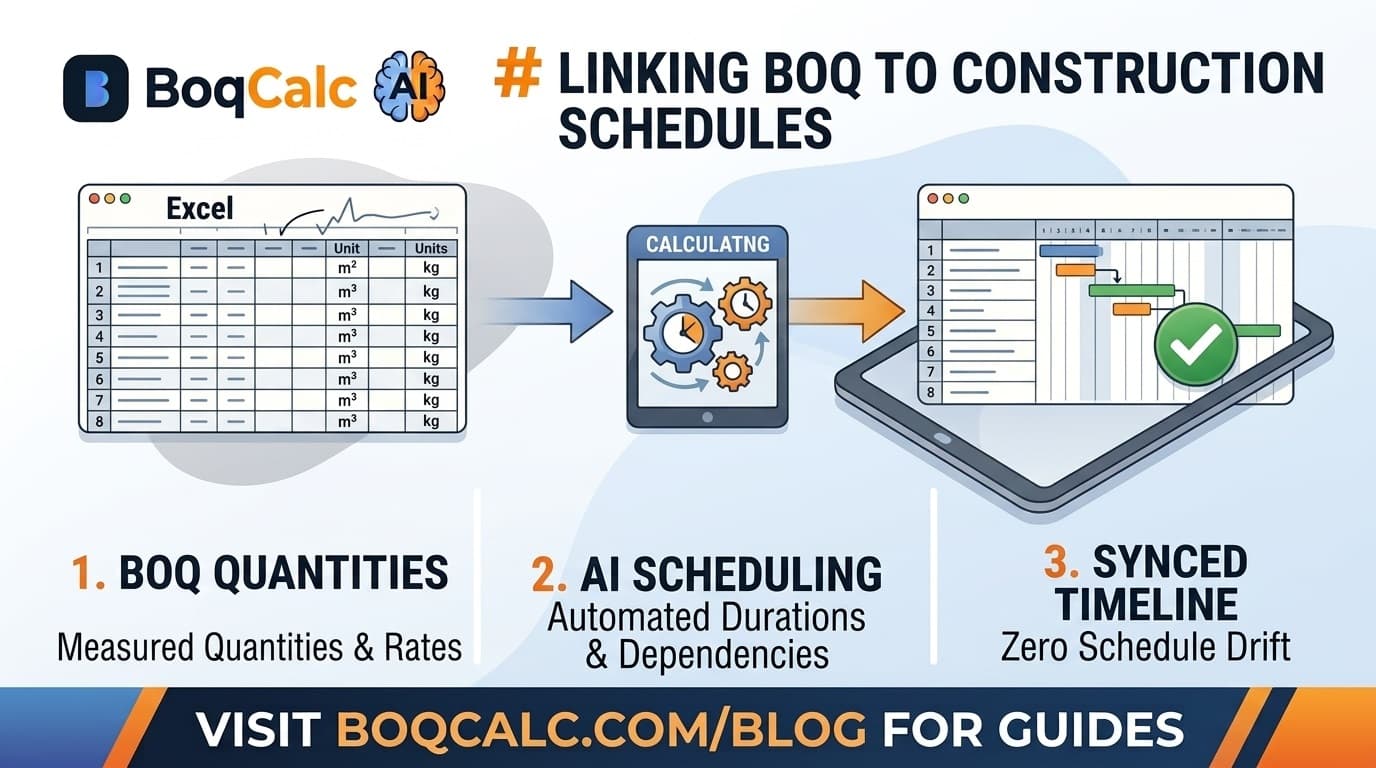
BoqCalc generates a dynamic schedule directly from the same priced BOQ quantities used for cost estimation, and the critical path is calculated as part of that schedule, not as a separate manual exercise. When the underlying BOQ changes, the schedule and its critical path are derived fresh from the updated data instead of needing a manual recalculation.
For how the schedule itself gets built from BOQ quantities in the first place, see our guide to turning a priced BOQ into a project timeline.
Frequently Asked Questions
Can a project have more than one critical path? Yes. If two or more paths through the network have exactly the same total duration, they're all critical simultaneously, and a delay on any of them delays the project.
Does the critical path ever change during a project? Regularly. A delay that eats into a non-critical task's float, a variation that adds a dependency, or simply finishing a critical task early can all shift which path is critical for the remainder of the project.
What's the difference between critical path and near-critical path? The critical path has zero float. A near-critical path has a small amount, often just a few days. It isn't currently determining the finish date, but a small delay is enough to make it critical too.
Is critical path analysis worth it on a small project? For a short project with few trades and simple sequencing, the benefit is smaller, but it still identifies which of the few tasks actually can't slip, which is useful even at small scale.
Conclusion
A schedule tells you what happens when. The critical path tells you which of those tasks actually can't move without moving the finish date with them. Knowing the difference is what turns a schedule from a planning document into something that actually protects a project's completion date under real-world pressure.
BoqCalc Team
From the BoqCalc team
Ready to price your next BOQ?
4 free credits, no credit card. Upload a BOQ and see the cost estimate, risk analysis, schedule, and cash flow for yourself.
Try BoqCalc free →