AI Construction Cost Estimation: Complete Guide for Contractors in 2026
 BoqCalc Team
Construction companies lose millions every year because of inaccurate estimates, missed scope items, outdated pricing, and rushed bidding processes.
Whether you're a contractor, estimator, quantity surveyor, or project manager, one thing is certain: accurate cost estimation determines whether a project becomes profitable or turns into a financial burden.
Today, artificial intelligence is transforming construction estimating. What previously required days of spreadsheet work can now be completed in minutes.
In this guide, you'll learn:
- What AI construction cost estimation is
- Why traditional estimating methods fail
- How AI improves bid accuracy
- Benefits for contractors and quantity surveyors
- Common implementation challenges
- The future of construction estimating
Why Construction Cost Estimation Matters
Before a contractor submits a bid, every quantity, labor hour, material cost, and subcontractor expense must be calculated accurately.
Even small mistakes can lead to:
- Underpriced bids
- Lost profit margins
- Budget overruns
- Change orders
- Delayed projects
As projects become more complex and competition increases, construction companies need faster and more reliable ways to prepare bids.
Traditional Construction Estimating Problems
Most companies still rely on a process that looks like this:
- Receive drawings and BOQ files
- Extract quantities manually
- Search for material prices
- Calculate labor costs
- Build schedules separately
- Review risk factors manually
This approach creates several challenges.
Human Error
Manual data entry inevitably leads to mistakes.
A single incorrect quantity or unit rate can significantly impact the final project value.
Outdated Pricing
Material prices fluctuate constantly, making it difficult to maintain accurate estimates.
Slow Turnaround
Preparing a detailed estimate often requires 15–25 hours for medium and large projects.
Hidden Risks
Traditional spreadsheets cannot automatically identify documentation inconsistencies, scope gaps, or missing specifications.
What Is AI Construction Cost Estimation?
AI construction cost estimation uses machine learning and automation to analyze project documentation and generate cost estimates automatically.
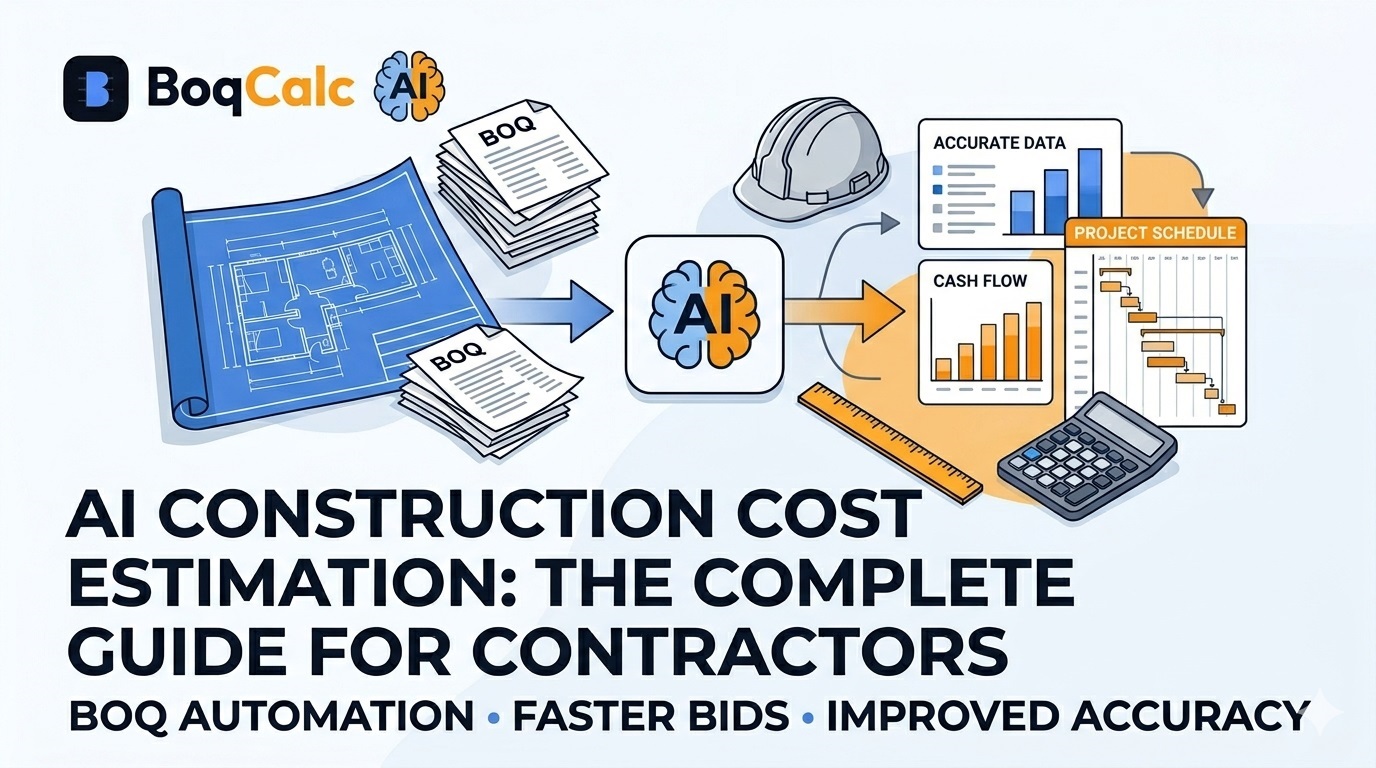
Instead of manually building spreadsheets, contractors upload:
- BOQ documents
- Technical specifications
- Drawings
- Tender documentation
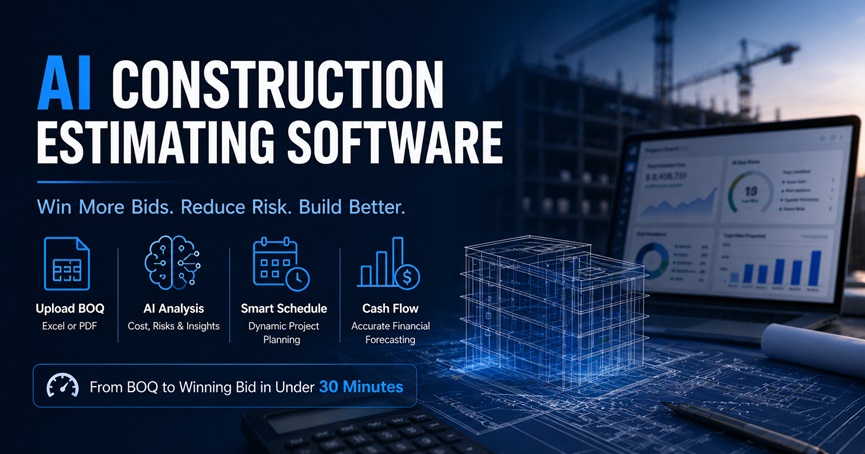
The system then:
- Extracts quantities
- Suggests pricing
- Identifies risks
- Creates schedules
- Generates cash-flow projections
For a deeper overview of modern AI estimating platforms, read our guide on AI Construction Estimating Software.
How AI Improves Construction Estimation Accuracy
Automated Quantity Analysis
AI scans Excel and PDF documents and identifies:
- Line items
- Units
- Quantities
- Trade categories
This significantly reduces repetitive manual work.
If you're new to BOQ workflows, see our article on How to Prepare a Bill of Quantities Online.
Intelligent Cost Recommendations
Machine learning models analyze historical project data and pricing patterns to suggest realistic cost ranges.
Risk Detection
Advanced systems identify:
- Missing specifications
- Incomplete documentation
- Scope gaps
- Unusual project complexity
This allows contractors to adjust contingencies before submitting bids.
Dynamic Project Scheduling
Modern AI solutions connect estimation and scheduling into a single workflow, improving project planning accuracy.
Benefits of AI for Contractors
Faster Bid Preparation
Projects that previously required days of work can now be analyzed in less than an hour.
Increased Bid Capacity
Estimators can process more tenders without increasing headcount.
Reduced Errors
Automation removes many manual calculation mistakes.
Better Profitability
Improved accuracy reduces the likelihood of underbidding and protects profit margins.
Standardized Workflows
Every estimate follows the same methodology and quality standards.
A practical example can be found in our article AI BOQ Estimation: How Contractors Save 80% Time Using Automation.
AI Construction Estimation vs Excel
| Feature | Excel | AI Estimation Software |
|---|---|---|
| Quantity Extraction | Manual | Automated |
| Risk Analysis | Manual | Automated |
| Schedule Creation | Separate Process | Integrated |
| Pricing Updates | Manual | Dynamic |
| Error Detection | Limited | Advanced |
| Scalability | Low | High |
While Excel remains useful for calculations, it lacks automation, pattern recognition, and predictive analysis.
Choosing the Best AI Construction Estimation Software
When evaluating estimating platforms, look for:
- BOQ automation
- Risk analysis
- Cash-flow forecasting
- Schedule generation
- Multi-user collaboration
- Tender comparison tools
- Excel and PDF support
You can compare leading solutions in our detailed review of the Best AI Construction Cost Estimation Software.
Who Should Use AI Estimation Software?
General Contractors
Faster tender preparation and improved bid quality.
Quantity Surveyors
More efficient quantity verification and pricing workflows.
Residential Builders
Accurate budgeting for renovations and new developments.
Infrastructure Firms
Managing large and highly complex BOQ structures.
Developers
Early-stage feasibility analysis and investment planning.
Future Trends in Construction Estimating
Over the next five years, AI estimating systems will likely evolve toward:
- Real-time material price integration
- Automated supplier quotations
- Predictive project risk scoring
- BIM integration
- Autonomous bid generation
Companies adopting these technologies early will gain a significant competitive advantage.
Frequently Asked Questions
What is AI construction cost estimation?
AI construction cost estimation uses machine learning to automate quantity extraction, pricing, risk analysis, and bid preparation.
Can AI replace construction estimators?
No. AI assists estimators by automating repetitive tasks while professionals focus on decision-making and project strategy.
How accurate are AI estimates?
Accuracy depends on project data quality, but modern AI systems significantly reduce human errors and improve consistency.
What documents are required?
Most platforms accept BOQ spreadsheets, PDF drawings, technical specifications, and tender documentation.
Is AI estimation suitable for small contractors?
Yes. Small and medium-sized contractors often benefit the most because they can increase estimating capacity without hiring additional staff.
Conclusion
Construction estimating is no longer just about spreadsheets.
AI-powered estimating platforms help contractors prepare bids faster, identify hidden risks, improve accuracy, and increase profitability. As projects become more complex and competition intensifies, companies that embrace AI-driven estimation will be better positioned to win contracts and protect margins.
The future of construction estimation is automated, data-driven, and powered by AI.
BoqCalc Team
From the BoqCalc team